A couple weeks ago, I rented the movie Tristan & Isolde. I'd wanted to see it when it was in theatres but, you know, those pesky kids and their inability to see rated R movies.
Funny thing is that the DVD sat on the TV cabinet for nearly two full weeks before I was in the mood to actually watch it. This is the kind of movie practically written to my personal tastes: a romance, set in medieval times, with a hunky knight hero and a beautiful lady. Throw in a handful of action scenes that aren't too gruesome and I'm in movie Nirvana. But, for whatever reason, until last night I just wasn't in the mood for it. Weird.
Anyway, the movie itself was pretty good. Not buy-the-DVD fantastic, but worth the two-hours to watch it good. Which leads me to ask why I didn't love love LOVE it since, like noted above, it contains all of the elements I want most in a good story.
For those unfamiliar, Tristan and Isolde is actually an ancient legend about starcrossed lovers and forbidden love. There are a variety of incarnations of the story, and on the DVD's Behind the Scenes featurette, the screenwriter said he felt this gave him some creative license to do what he wanted with the script since there was no "definitive" original. I'm fine with that. I'm even more fine because the writer chose to leave out the love potions that you often find in the traditional Tristan and Isolde tales. I want real love, not manufactured lust.
Anyway, the story is frameworked on the Arthur/Lancelot/Guinevere love triangle almost exactly, although technically Tristan and Isolde came first so it's the other way around. Tristan is a knight, serving Lord Marke during the period in history after the Romans had withdrawn from Britain and all of the tribes were fueding with each other. These tribes face a common enemy - the king of Ireland - yet they can't seem to get it together enough to fight as one entity and defeat him. During one battle with the Irish, Tristan is wounded with a poisoned sword. The wound isn't mortal, but the poison paralyzes him enough that his comrades determine he's good and dead and send him out to sea on a funeral pyre boat. Thankfully a passing rain shower keeps the not-dead Tristan from burning to a crisp.
Eventually Tristan's boat washes up on the Irish shore, where he is discovered by the king's daughter, Isolde. She tends to his wounds and heals him, hiding the Englishman from her father while giving Tristan a false name so he won't know who she really is (not sure why she does this). During his recouperation, Tristan and Isolde fall in love. This is the best part of the movie, IMO, the only part that inspired me to rewatch all of ten minutes.
Tristan must return to England since it is rather suicidal of him to stay in Ireland, and when he gets back, he's adequately mopey, despondent over having had to leave Isolde behind. He'd asked her to come with, but she declined for reasons I'm still not quite sure about. When the Irish king offers his daughter as a prize in a tournament, hoping that this contest will further alienate the various English tribes from each other, Tristan leaps at the chance to go back to Ireland and fight in Lord Marke's name, no doubt hoping he'll score a bride for his master and find his own lady love and convince her to come back to England this time. Or maybe just drag her off by her hair so he can stop moping.
Naturally, Tristan wins the tournament. And, naturally, he is devastated to learn that the bride he has won for Lord Marke is none other than Isolde.
Okay...from here on out are SPOILERS, so read on at your own risk.
Tristan and Isolde return to England. Despite her pleas for them to run off and be together, Tristan remains firm and insists that honor and duty are more important than love, telling Isolde she must marry Marke and they must forget about their feelings for each other. Isolde marries Marke. What follows is probably the most realistic portrayal of wedding night sex between two strangers in an arranged marriage I've ever encountered. But Isolde holds up like a trooper. Marke is a good man, she can't help but like him, and even if she wishes every single second that it was Tristan in her life and bed, she sucks it up fairly well.
Tristan, on the other hand, doesn't do so good. He walks around with perpetual tears in his eyes, slowly going crazy over the idea of Isolde with Marke. When he accuses her of liking Marke too much, she throws it back at him that it was him who told her she had to do her duty. But she also tells him she will meet him whenever he wants for a little on-the-side nookie. Tristan folds like a house of cards, and their affair begins.
As you might suspect, everything falls apart when enemies of Marke conspire with the Irish king and the lovers are revealed. I won't be specific, suffice it to say, the ending is far from the normal romance HEA. Tristan and Isolde is, was, and always will be a tragedy in the fine Romeo and Juliet tradition.
So, other than the ending, what was it about this movie that didn't quite nail it for me? I'm hard pressed to say. The actors chosen for the roles were well placed. Sophia Myles was beautiful as Isolde, but not so gorgeous as to make her completely unreal. Rufus Sewell fit the idea of an Arthur-like ruler, strong yet capable of falling in love with Isolde and feeling real pain when he thinks she has feelings for another man. And James Franco made an amazing young knight, handsome and brave and sexy enough to entice any married woman to stray.
Although, I do think Franco played the despondent lover a little too damply. He spent a healthy portion of the movie with tears in his eyes. While I think it an admiral trait for an actor - especially a male one - to be able to summon tears when necessary, it's hard to imagine a real man of that time walking around looking as if he were about to burst out sobbing at any second. Sure, you really got the sense that Tristan was suffering, but I don't know that the constant waterworks made me believe Tristan and Isolde's love was any deeper or more passionate or more tragic than any other love. More, I got the idea that if the movie had been set in modern times, Tristan would have been the type to write bad poetry and listen to Air Supply ad nauseum. He was just a bit too nouveaux sensitive man for the time being portrayed.
Another thing that got me because it bordered on the Big Mis. After Marke discovers Tristan and Isolde's affair, he locks Tristan in the dungeon (of course). When he asks Tristan to explain, I'm screaming at the screen for Tristan to tell Marke how he had met Isolde in Ireland, before the contest and before knowing who she really was and what winning her would mean. But Tristan - tearfully - keeps his silence. As if nothing he could say would justify what he had done. Thing is, Marke wasn't an evil character who would be so consumed by the affront to his ego that he wouldn't have understood the situation.
In fact, when Isolde - wisely - tells Marke the truth of the matter, he forgives them both. He can see that this wasn't a betrayal of him based on the over-active libido of two people who should have controlled it, but rather the continuation of something that had started long before he entered the picture. In fact, in light of his feelings for Isolde, Tristan's actions were almost heroic. Instead of running off with her as he most likely wanted to do more than anything, he brought her home to Lord Marke and watched the woman he loved become the wife of another man.
Finally, because of the situation of the story, there was no way to acheive any sort of happily ever after. Not that I need to always have the HEA to enjoy something. But I need to feel good about what happened before the unhappily ever after. At one point, Isolde asks Tristan why loving him felt so wrong. I agreed with her. No matter how deep or passionate or true their love for each other was, because of the situation, no one could ever feel good about it. Even if Marke had died and the two of them could have been together legitimately, it all felt wrong.
And this isn't even because the two were committing adultry. Because their love pre-dated Isolde's marriage to Marke, because she didn't have any choice in marrying Marke, I didn't feel that Isolde wronged anyone by having an affair with Tristan. It's not as if she promised Marke she would remain faithful because she had feelings for the man. Her marriage was all about duty, and for Isolde, love trumped duty hands down. Tristan, on the other hand, felt the opposite, so his betrayal of Marke struck him more deeply. The sacrifice for being with Isolde was simply too great, or at least too great for the love we'd been shown on screen. That love didn't ring strong enough for me to bear the burden of the crimes the two lovers were committing.
I think the mistake happened when Isolde refused to return to England with Tristan at the very beginning. After that, there was no going back. And since I'm still not quite sure why she didn't just go with him - her sense of love being more important than any duty to her father or her people - all that followed felt false.
Which explains much to me about the Arthur/Lancelot/Guinevere scenario. I always wondered why Lancelot and Guinevere never got together after Arthur was killed. Even if those around them would have accepted such a match, something about it would have always been wrong.
I suppose this is why I'm not a big fan of love triangle stories. I'm not liking much the Jack/Kate/Sawyer thing on Lost, either. Someone is going to get hurt. And when no-one is a bad guy, even the winners become losers.
In the end, I give Tristan & Isolde a B-. Worth watching once because it does get a couple things right. But I guess I just like a little less tragedy in my Tragic Love Stories.
Wednesday, May 31, 2006

Friday, May 26, 2006
Good For You and Tastes Good, Too
I tend to hold a reverse prejudice against literary fiction. Not that I haven't read a lot of it in my day. Honestly, some of the best books I've ever read are literary fiction. The Red Tent by Anita Diamant. Barbara Kingsolver's The Poisonwood Bible. Sea Glass by Anita Shreve. Where the Heart Is by Billie Letts, although this last one might be labeled a romance by the purists among us. I've been in book clubs and I consider myself fairly well read, so it's not like I avoid literary fiction as a rule. My snobbery comes in the form of defense against those who snub their noses at anything non-literary. Any time a group of people shoves something in my face and declares it better than what I do/read/write/enjoy, I'm prewired to reject it as a matter of course.
This said, my latest read is what I would consider a literary novel. It's actually labelled Young Adult, but I enjoyed it thoroughly on a very adult level. Whatever it is, it's certainly not romance in any shape or form.
Red Kayak by Priscilla Cummings is the story about 13-year-old Brady Parks, a boy who lives and works on the shores and waterways of the Chesapeake Bay. He's a good kid, mature beyond his years, with loving parents and a good if not easy life. His friends are true, and until one fateful morning changes everything, Brady's future looks bright. A young mother and her son, Brady's neighbors, take a morning kayak ride that turns tragic when the kayak sinks and the three-year-old boy nearly drowns. Brady is instrumental in the rescue of Ben D'Angelo, but his efforts prove fruitless when the boy eventually dies from over-exposure to the chilly water. Brady is crushed and finds it difficult to handle the senseless death of someone so young.
But things become even more complicated when Brady discovers evidence that the kayak accident might not have been so much an accident as sabotage. Even worse, it looks as if his two best friends might have had a hand in it. Brady struggles desperately with what to do; the right thing, which might ruin his own life as well as those of his friends, or the easy thing, which isn't necessarily the easiest when his own conscience begins to pull at him.
The story is told in first person from Brady's POV. He's an amazing kid, level headed and responsible beyond his years. In fact, if I'd have any criticism at all, it might be that Brady is somewhat adult in his outlook on the world considering his lack of time in it. But this didn't detract from the story one bit because when Brady finds himself facing the grieving Mrs. D'Angelo the first time or when he discovers the evidence that implicates his friends, his utter lack of direction rings so very true. He struggles terribly in situations that would make any adult squirm.
The suspense in the story is tightly woven yet so subtly accomplished you don't realize why it is you just can't put the book down. From page to page I turned, wondering what Brady would do. Yet there wasn't that heart-pounding tension in so many suspense novels where the good guy is running from the bad guy, trying to prove himself innocent or them guilty. Brady's struggle was mostly internal, and time after time I ached for him to just tell his parents or his older cousin, Carl, so the poor boy could unload his heavy burden from his own, narrow shoulders.
The ending is not pat. Things don't get easy for anyone. Cummings has a chance to cop out with some easy solutions, giving heart-string-tugging motivation behind the actions of Brady's two misguided friends that could allow her to wash her hands of the mess she's created. But she doesn't do that, even though all loose strings were tied up neatly and there is a definite sense of completion and hope. Brady grew on me as a character in such a way that I want to know what happens to him next. The sign of a truly good book for me is when I'm sad to finish the last page and leave the character behind when I'd just as soon keep on hanging out with him or her. I'll miss Brady Parks. A lot.
This book reminded me a lot of John Knowle's A Separate Peace. I read that book over 20 years ago, in high school, but the theme of the actions of meanness and their repercussions still echo in that dusty corner of my brain occupied by Great Works of Literature I was made to read.
If you are looking for something that goes down smooth yet leaves you with more than empty calories, pick up this book and give it a chance. Red Kayak is up for a 2007 Rebecca Caudill award, and I certainly think it deserves a lot of recognition. At the very least, I hope teachers out there discover this potential classic and encourage kids to read it. It certainly make you think about what's right and what's easy and what you might do in such a situation.
It gives literary fiction a good name.
This said, my latest read is what I would consider a literary novel. It's actually labelled Young Adult, but I enjoyed it thoroughly on a very adult level. Whatever it is, it's certainly not romance in any shape or form.
Red Kayak by Priscilla Cummings is the story about 13-year-old Brady Parks, a boy who lives and works on the shores and waterways of the Chesapeake Bay. He's a good kid, mature beyond his years, with loving parents and a good if not easy life. His friends are true, and until one fateful morning changes everything, Brady's future looks bright. A young mother and her son, Brady's neighbors, take a morning kayak ride that turns tragic when the kayak sinks and the three-year-old boy nearly drowns. Brady is instrumental in the rescue of Ben D'Angelo, but his efforts prove fruitless when the boy eventually dies from over-exposure to the chilly water. Brady is crushed and finds it difficult to handle the senseless death of someone so young.
But things become even more complicated when Brady discovers evidence that the kayak accident might not have been so much an accident as sabotage. Even worse, it looks as if his two best friends might have had a hand in it. Brady struggles desperately with what to do; the right thing, which might ruin his own life as well as those of his friends, or the easy thing, which isn't necessarily the easiest when his own conscience begins to pull at him.
The story is told in first person from Brady's POV. He's an amazing kid, level headed and responsible beyond his years. In fact, if I'd have any criticism at all, it might be that Brady is somewhat adult in his outlook on the world considering his lack of time in it. But this didn't detract from the story one bit because when Brady finds himself facing the grieving Mrs. D'Angelo the first time or when he discovers the evidence that implicates his friends, his utter lack of direction rings so very true. He struggles terribly in situations that would make any adult squirm.
The suspense in the story is tightly woven yet so subtly accomplished you don't realize why it is you just can't put the book down. From page to page I turned, wondering what Brady would do. Yet there wasn't that heart-pounding tension in so many suspense novels where the good guy is running from the bad guy, trying to prove himself innocent or them guilty. Brady's struggle was mostly internal, and time after time I ached for him to just tell his parents or his older cousin, Carl, so the poor boy could unload his heavy burden from his own, narrow shoulders.
The ending is not pat. Things don't get easy for anyone. Cummings has a chance to cop out with some easy solutions, giving heart-string-tugging motivation behind the actions of Brady's two misguided friends that could allow her to wash her hands of the mess she's created. But she doesn't do that, even though all loose strings were tied up neatly and there is a definite sense of completion and hope. Brady grew on me as a character in such a way that I want to know what happens to him next. The sign of a truly good book for me is when I'm sad to finish the last page and leave the character behind when I'd just as soon keep on hanging out with him or her. I'll miss Brady Parks. A lot.
This book reminded me a lot of John Knowle's A Separate Peace. I read that book over 20 years ago, in high school, but the theme of the actions of meanness and their repercussions still echo in that dusty corner of my brain occupied by Great Works of Literature I was made to read.
If you are looking for something that goes down smooth yet leaves you with more than empty calories, pick up this book and give it a chance. Red Kayak is up for a 2007 Rebecca Caudill award, and I certainly think it deserves a lot of recognition. At the very least, I hope teachers out there discover this potential classic and encourage kids to read it. It certainly make you think about what's right and what's easy and what you might do in such a situation.
It gives literary fiction a good name.
Wednesday, May 24, 2006
So...Tempting...
My family got me The Sims 2 for Mother's Day.
It's something I had asked for, so I was quite pleased to receive it.
But here it is, two weeks after Mother's Day, and I have yet to load the program on my machine to start playing with it. Because I'm really scared.
Scared that it's going to suck so much time the entire world will feel the pull toward my exact latitude and longitude, possibly throwing the time-space continuum as we know it into chaos.
I never do anything less than 110%. When I latch onto an idea or interest or hobby or passion, I jump in with both feet, entire torso, arms, fingers, head, hair, everything. I don't believe in dabbling. I go for full life immersion or nothing.
So loading up Sims 2 and creating characters and worlds and building houses - all of which sounds so cool to me - stands to pretty much take over my entire life. This is something I just can't afford right now. We are heading into summer vacation, which means my time already will be sucked dry with kid-things and trips and summer stuff. Last thing I need is a new addiction to a cyber-world.
Funny thing, the reason I wanted Sims 2 in the first place is that I thought it might allow me to take my characters and make them three dimensional. I thought, perhaps, I might be able to work out some scenarios on my computer screen, get an idea of how things really look outside the theatre of my brain. But I know what will happen is that I'll get wrapped up in stuff that has nothing whatsoever to do with my current WIPs. Before I know, three months will have passed by with not a single word added to anything I'm working on right now, but I'll have a couple dozen new characters clamoring to be heard.
I must follow the advice of Nancy Reagan. I'm just saying No to Sims 2.
For now.
It's something I had asked for, so I was quite pleased to receive it.
But here it is, two weeks after Mother's Day, and I have yet to load the program on my machine to start playing with it. Because I'm really scared.
Scared that it's going to suck so much time the entire world will feel the pull toward my exact latitude and longitude, possibly throwing the time-space continuum as we know it into chaos.
I never do anything less than 110%. When I latch onto an idea or interest or hobby or passion, I jump in with both feet, entire torso, arms, fingers, head, hair, everything. I don't believe in dabbling. I go for full life immersion or nothing.
So loading up Sims 2 and creating characters and worlds and building houses - all of which sounds so cool to me - stands to pretty much take over my entire life. This is something I just can't afford right now. We are heading into summer vacation, which means my time already will be sucked dry with kid-things and trips and summer stuff. Last thing I need is a new addiction to a cyber-world.
Funny thing, the reason I wanted Sims 2 in the first place is that I thought it might allow me to take my characters and make them three dimensional. I thought, perhaps, I might be able to work out some scenarios on my computer screen, get an idea of how things really look outside the theatre of my brain. But I know what will happen is that I'll get wrapped up in stuff that has nothing whatsoever to do with my current WIPs. Before I know, three months will have passed by with not a single word added to anything I'm working on right now, but I'll have a couple dozen new characters clamoring to be heard.
I must follow the advice of Nancy Reagan. I'm just saying No to Sims 2.
For now.
Friday, May 19, 2006
Well, Jim, I Was Walking Down The Street...
Meljean made a comment to Wednesday's post that ties in with my current dialogue issues:
"I find I end up with speeches." Meljean remarked.
I'm with you on that one, too. If my characters aren't exchanging banal banter, one character is monologuing at the other one.
This is an especially tough challenge when I want one character to divulge some bit of backstory to another character. I have yet to master the art of dripping backstory into the main narrative in such a way that readers absorb it by osmosis. Instead, I seem to rely on one character going the "When I was a lad..." approach.
But, in my defense, I feel somewhat as if my hands were tied. A lot of my characters have interesting backstories, and usually there is one or two defining incidences that have put them in the position of being the right character for the particular story at hand. Many times, I have imagined these character-shaping scenes in my head to great detail, and it makes me sick to boil them down to something as simple as "my mother was a bitch" or "my boyfriend left me when I was sixteen." A lot of times, those backstory events are as interesting to me as the story at hand. (And did you notice the liberal use of to me, since I do know that sometimes backstory is boring to everyone else.)
Since prologues in general are a no-no, that leaves me either to ignore backstory-critical moments or to find another way to reveal what happened. I know flashback can be used to great advantage, but I also know that it takes a master to work flashback in such a way as to keep the current story from grinding to a sickening halt. I'm working on mastering that technique.
Meanwhile, I seem to rely on the old "Tell me what happened..." dialogue, wherein said characters are in such a place with some time to kill that they can bare their deepest darkest secrets. I find that this method accomplishes a couple things for me.
1) It demonstrates that the characters - usually the hero and heroine, but sometimes two good friends - have reached a point in their relationship where trust has solidified enough to reveal their damaged selves.
2) It establishes a new sense of intimacy between the characters. After the confessing, they know each other better than anyone else. There is a new level of connection there.
3) It explains to Character A why Character B behaves in a certain way and clears up any Big or Not-So-Big Misunderstandings that hover beneath the surface.
4) It allows me to portray relevant backstory in such a way that it (hopefully) effects the reader on an emotional level, helping her (or him) to empathise with the character more deeply. Well, yeah, if the evil step-dad killed her puppy, no wonder she hates all men with a passion.
5) It allows me to show, not tell. Sort of. Technically, one character is telling the other character what happened. But in the words chosen, it the depth of description and details revealed, you can achieve so much more than what could happen in straight narrative.
6) Because the injured character is reliving the past vicariously in the telling of it, you can bring to fore emotions that character might have experienced at the time. Nothing more effective than that big, strong Alpha-male breaking down sobbing as he explains how devastated he was when his mother died when he was only 10.
So, as I see it, lots of good reasons to use conversation as a place for backstory dumpage. But I do know it needs to be done with some finesse. That's the part I'm struggling with. How to go about things so you don't end up with pages and pages of paragraphs with only the occasional quotation mark to remind the reader that someone is speaking and that they haven't accidentally walked into a 1st person POV story run amok.
A final benefit to this method, albeit one the readers might not ever see or appreciate, is the ability to have the character tell his or her story in his or her voice (allowing practice in nailing that voice) and having all the pertinent details spelled out in one place. Kind of akin to having a character write his or her own biography during the character creation phase, only on an incident-specific level.
I'm a big fan of the "Tell me what happenened..." approach. Hope that's okay.
"I find I end up with speeches." Meljean remarked.
I'm with you on that one, too. If my characters aren't exchanging banal banter, one character is monologuing at the other one.
This is an especially tough challenge when I want one character to divulge some bit of backstory to another character. I have yet to master the art of dripping backstory into the main narrative in such a way that readers absorb it by osmosis. Instead, I seem to rely on one character going the "When I was a lad..." approach.
But, in my defense, I feel somewhat as if my hands were tied. A lot of my characters have interesting backstories, and usually there is one or two defining incidences that have put them in the position of being the right character for the particular story at hand. Many times, I have imagined these character-shaping scenes in my head to great detail, and it makes me sick to boil them down to something as simple as "my mother was a bitch" or "my boyfriend left me when I was sixteen." A lot of times, those backstory events are as interesting to me as the story at hand. (And did you notice the liberal use of to me, since I do know that sometimes backstory is boring to everyone else.)
Since prologues in general are a no-no, that leaves me either to ignore backstory-critical moments or to find another way to reveal what happened. I know flashback can be used to great advantage, but I also know that it takes a master to work flashback in such a way as to keep the current story from grinding to a sickening halt. I'm working on mastering that technique.
Meanwhile, I seem to rely on the old "Tell me what happened..." dialogue, wherein said characters are in such a place with some time to kill that they can bare their deepest darkest secrets. I find that this method accomplishes a couple things for me.
1) It demonstrates that the characters - usually the hero and heroine, but sometimes two good friends - have reached a point in their relationship where trust has solidified enough to reveal their damaged selves.
2) It establishes a new sense of intimacy between the characters. After the confessing, they know each other better than anyone else. There is a new level of connection there.
3) It explains to Character A why Character B behaves in a certain way and clears up any Big or Not-So-Big Misunderstandings that hover beneath the surface.
4) It allows me to portray relevant backstory in such a way that it (hopefully) effects the reader on an emotional level, helping her (or him) to empathise with the character more deeply. Well, yeah, if the evil step-dad killed her puppy, no wonder she hates all men with a passion.
5) It allows me to show, not tell. Sort of. Technically, one character is telling the other character what happened. But in the words chosen, it the depth of description and details revealed, you can achieve so much more than what could happen in straight narrative.
6) Because the injured character is reliving the past vicariously in the telling of it, you can bring to fore emotions that character might have experienced at the time. Nothing more effective than that big, strong Alpha-male breaking down sobbing as he explains how devastated he was when his mother died when he was only 10.
So, as I see it, lots of good reasons to use conversation as a place for backstory dumpage. But I do know it needs to be done with some finesse. That's the part I'm struggling with. How to go about things so you don't end up with pages and pages of paragraphs with only the occasional quotation mark to remind the reader that someone is speaking and that they haven't accidentally walked into a 1st person POV story run amok.
A final benefit to this method, albeit one the readers might not ever see or appreciate, is the ability to have the character tell his or her story in his or her voice (allowing practice in nailing that voice) and having all the pertinent details spelled out in one place. Kind of akin to having a character write his or her own biography during the character creation phase, only on an incident-specific level.
I'm a big fan of the "Tell me what happenened..." approach. Hope that's okay.
Wednesday, May 17, 2006
Speech Impediments
I love writing dialogue. A lot of times, I'll type dialogue without any quotation marks or speech tags, just letting the back-and-forth flow from my fingers as if I were transcribing a conversation. I then go back and add in who's saying what to whom, what they are doing, expressions and reactions, the like.
Only thing is, I'm finding my dialogue is chock full of speech tics. Not so much the "ums" we all stammer on occasion, especially when we feel put on the spot. I'm talking about the "Ohs" and the "Wells" and the "Yeahs." Not to mentions quite a few "Sos".
I end up with something like this.
"Well, I think it's time we have a talk," Brenda said.
"Oh?" Barney replied. "I'm don't know. We've gone this long - "
"Yeah, and I'm getting pretty tired of it. When we started this relationship, I thought things were going to be fifty-fifty. Full partners."
"So, what's the problem?" Barney steeled himself, preparing for the worst.
"Well?" Brenda glared at him. "Are you ever going to let me hold the remote?"
I also find that my characters do a lot of echoing, as if they stood at the bottom of the Grand Canyon.
"I can't believe you're accusing me of that," Barney said.
"Accusing you of what?" Brenda replied.
"Of hogging the remote. Didn't you have it just last night?"
Brenda snorted. "Last night? I was out with the girls last night."
"Oh, yeah," he said. "That's right. But I know you had it the night before."
If my characters aren't throwing around empty-calorie words or repeating each other, they're asking "what" way more than they should, as if they'd been hit with some hearing problem or are kind of on the obtuse side.
"What are you going to do about it?"
"What?" Barney said.
"The remote. How are we going to work this out?" Brenda demanded.
"Well, we could go with the Monday, Wednesday, Friday and Tuesday, Thursday, Saturday approach, with alternate Sundays thrown in."
Brenda studied him a long moment. "You know something?"
"What?"
"I love you."
I think my problem comes from transcribing dialogue as I hear it in real life. I want things to sound and flow naturally, hoping that if my characters sound like they are talking like real, living and breathing human beings do, they will come across as three-dimensional, real people. It's not so much that I engage in bagels n' coffee talk, wherein my characters go through the whole hello-how are you-I'm fine-how's the family-great, and yours song and dance. Nor do they discuss weather or the state of current sports scores. The dialogue I write is necessary to move the story forward and reveals things about the characters and their relationships with each other.
It just seems to take them a long time to get anywhere. Not to mention, this habit is killer on my word count. I might reach 10,000 words and discover a good 2,000 of them are filler speech tics.
I need to work on this. Yeah.
Only thing is, I'm finding my dialogue is chock full of speech tics. Not so much the "ums" we all stammer on occasion, especially when we feel put on the spot. I'm talking about the "Ohs" and the "Wells" and the "Yeahs." Not to mentions quite a few "Sos".
I end up with something like this.
"Well, I think it's time we have a talk," Brenda said.
"Oh?" Barney replied. "I'm don't know. We've gone this long - "
"Yeah, and I'm getting pretty tired of it. When we started this relationship, I thought things were going to be fifty-fifty. Full partners."
"So, what's the problem?" Barney steeled himself, preparing for the worst.
"Well?" Brenda glared at him. "Are you ever going to let me hold the remote?"
I also find that my characters do a lot of echoing, as if they stood at the bottom of the Grand Canyon.
"I can't believe you're accusing me of that," Barney said.
"Accusing you of what?" Brenda replied.
"Of hogging the remote. Didn't you have it just last night?"
Brenda snorted. "Last night? I was out with the girls last night."
"Oh, yeah," he said. "That's right. But I know you had it the night before."
If my characters aren't throwing around empty-calorie words or repeating each other, they're asking "what" way more than they should, as if they'd been hit with some hearing problem or are kind of on the obtuse side.
"What are you going to do about it?"
"What?" Barney said.
"The remote. How are we going to work this out?" Brenda demanded.
"Well, we could go with the Monday, Wednesday, Friday and Tuesday, Thursday, Saturday approach, with alternate Sundays thrown in."
Brenda studied him a long moment. "You know something?"
"What?"
"I love you."
I think my problem comes from transcribing dialogue as I hear it in real life. I want things to sound and flow naturally, hoping that if my characters sound like they are talking like real, living and breathing human beings do, they will come across as three-dimensional, real people. It's not so much that I engage in bagels n' coffee talk, wherein my characters go through the whole hello-how are you-I'm fine-how's the family-great, and yours song and dance. Nor do they discuss weather or the state of current sports scores. The dialogue I write is necessary to move the story forward and reveals things about the characters and their relationships with each other.
It just seems to take them a long time to get anywhere. Not to mention, this habit is killer on my word count. I might reach 10,000 words and discover a good 2,000 of them are filler speech tics.
I need to work on this. Yeah.
Monday, May 15, 2006
This 'N That
Hope everyone had a wonderful Mother's Day.
Mine was quite nice. My husband, for all he loves to drive me crazy, knows exactly how to give me a lovely Mother's Day. He wrangled the kids - took them shopping and out to lunch - in order to give me some peace and quiet. I used this time to write and ended up spending almost the entire day lost in my story. I honestly can't think of a nicer way to spend a dreary Sunday, so I'd have to say my day was pretty close to perfect.
And, to end it all, the final episode of The West Wing aired. I'm sad the show is over. It was one of only a couple that both hubby and I enjoyed and could watch together. The characters were wonderfully three-dimensional, the dialogue so sharp and quick I often had to watch a second or third time to get it all. The cast was extraordinary: I honestly don't think I can recall a single performance by a regular or guest that I didn't find spot on.
I'm going to miss the show a lot. I understand that this was the best time for it to end, while it was still good and at the natural break between the Bartlett administration and the one to follow. But over the past two seasons, I've gotten to know the new characters well enough that I think another season or two following their progress might have been nice.
My daughter and I watched Bridget Jones' Diary this weekend. I'd seen it before, of course, but I'd forgotten how funny the movie is. The fight between Colin Firth and Hugh Grant is laugh-out-loud worthy. I don't know what the British folks out there think, because I know they were a bit miffed over the casting of Renee Zellweger as Bridget, but I think she did an amazing job in the role. And of course Colin Firth knocked me out with his Mark Darcy.
Funny thing is that I have the book but I've never read it. Now I'm motivated to do so, and after the first chapter or so, I'm really enjoying it.
Which leads me to declare that I honestly believe I may be one of only 10 people in the whole wide world who hasn't read Dan Brown's The DaVinci Code. I'm actually holding off now until I see the movie, because I figure I'm one of the very few who will be able to give an honest assessment of the movie as a movie rather than how it compares to the book. Newspapers should call me up for interviews, don't you think?
Only three and half weeks until school lets out for the summer. I'm starting to panic.
Mine was quite nice. My husband, for all he loves to drive me crazy, knows exactly how to give me a lovely Mother's Day. He wrangled the kids - took them shopping and out to lunch - in order to give me some peace and quiet. I used this time to write and ended up spending almost the entire day lost in my story. I honestly can't think of a nicer way to spend a dreary Sunday, so I'd have to say my day was pretty close to perfect.
And, to end it all, the final episode of The West Wing aired. I'm sad the show is over. It was one of only a couple that both hubby and I enjoyed and could watch together. The characters were wonderfully three-dimensional, the dialogue so sharp and quick I often had to watch a second or third time to get it all. The cast was extraordinary: I honestly don't think I can recall a single performance by a regular or guest that I didn't find spot on.
I'm going to miss the show a lot. I understand that this was the best time for it to end, while it was still good and at the natural break between the Bartlett administration and the one to follow. But over the past two seasons, I've gotten to know the new characters well enough that I think another season or two following their progress might have been nice.
My daughter and I watched Bridget Jones' Diary this weekend. I'd seen it before, of course, but I'd forgotten how funny the movie is. The fight between Colin Firth and Hugh Grant is laugh-out-loud worthy. I don't know what the British folks out there think, because I know they were a bit miffed over the casting of Renee Zellweger as Bridget, but I think she did an amazing job in the role. And of course Colin Firth knocked me out with his Mark Darcy.
Funny thing is that I have the book but I've never read it. Now I'm motivated to do so, and after the first chapter or so, I'm really enjoying it.
Which leads me to declare that I honestly believe I may be one of only 10 people in the whole wide world who hasn't read Dan Brown's The DaVinci Code. I'm actually holding off now until I see the movie, because I figure I'm one of the very few who will be able to give an honest assessment of the movie as a movie rather than how it compares to the book. Newspapers should call me up for interviews, don't you think?
Only three and half weeks until school lets out for the summer. I'm starting to panic.
Friday, May 12, 2006
Be All That You Want to Be
Know what the very best thing about having a writer's brain is? It's the ability to be anyone and to do anything.
The other day I happened to cruise past my local UBS, and I thought about how cool it would be to own a used book store. I thought about how crammed full of books my UBS - called Cornerstone Books - is, how it has floor-to-ceiling shelves from wall to wall overflowing with used books of every genre and subgenre. The romance section is situated all the way in the back, with overflow heading into the stock room (and I've mentioned how I'm never sure if I'm allowed to peruse the offerings in this stock room, but I do anyway). I thought about how the UBS in my mother's town has an amazing romance novel section, with books divided and subdivided by theme, author, subgenre, etc.
Which led me to thinking about how I would do it if I owned a UBS.
Then I wondered if a UBS dedicated to selling only (or primarily) romance books would ever be viable as a business entity. Would it go under because there isn't a big enough market or would it be a smashing success because it focuses on one small slice of the reading pie in such a way as to do it justice? I even thought of a great name for it: Romancelandia Books.
But, being practical and a realist, I do know the downside of owning a bookstore, or any service-related business for that matter. You have to work crazy hours, including weekends. You have to stress about employees, inventory, vendors, payroll, rent, etc. All those minute details required to operate a business. Owning your own store/restaurant/whatever involves pretty much an entire-life commitment, and unless you are unique in some way, chances of long-term success are pretty slim.
BUT...I rationalized as I drove around...no reason one of my fictional characters couldn't own a bookstore. No reason I couldn't live out the fantasy, even including the downside, on paper. Talk about low risk, no risk, right? And because it's my world I'm creating, my character's endeavor CAN be a smashing success simply because I say so, assuming, of course, I've made a reasonably realistic case for it.
So, no matter what zany idea occurs to me - like back during my junior year of college when my roommate and I went to Sea World over spring break and I decided I wanted to become a dolphin trainer - I can find a way to make it happen. In the course of my small lifetime, I can be anything I want to be via the characters that I bring to life.
How cool is that?!
The other day I happened to cruise past my local UBS, and I thought about how cool it would be to own a used book store. I thought about how crammed full of books my UBS - called Cornerstone Books - is, how it has floor-to-ceiling shelves from wall to wall overflowing with used books of every genre and subgenre. The romance section is situated all the way in the back, with overflow heading into the stock room (and I've mentioned how I'm never sure if I'm allowed to peruse the offerings in this stock room, but I do anyway). I thought about how the UBS in my mother's town has an amazing romance novel section, with books divided and subdivided by theme, author, subgenre, etc.
Which led me to thinking about how I would do it if I owned a UBS.
Then I wondered if a UBS dedicated to selling only (or primarily) romance books would ever be viable as a business entity. Would it go under because there isn't a big enough market or would it be a smashing success because it focuses on one small slice of the reading pie in such a way as to do it justice? I even thought of a great name for it: Romancelandia Books.
But, being practical and a realist, I do know the downside of owning a bookstore, or any service-related business for that matter. You have to work crazy hours, including weekends. You have to stress about employees, inventory, vendors, payroll, rent, etc. All those minute details required to operate a business. Owning your own store/restaurant/whatever involves pretty much an entire-life commitment, and unless you are unique in some way, chances of long-term success are pretty slim.
BUT...I rationalized as I drove around...no reason one of my fictional characters couldn't own a bookstore. No reason I couldn't live out the fantasy, even including the downside, on paper. Talk about low risk, no risk, right? And because it's my world I'm creating, my character's endeavor CAN be a smashing success simply because I say so, assuming, of course, I've made a reasonably realistic case for it.
So, no matter what zany idea occurs to me - like back during my junior year of college when my roommate and I went to Sea World over spring break and I decided I wanted to become a dolphin trainer - I can find a way to make it happen. In the course of my small lifetime, I can be anything I want to be via the characters that I bring to life.
How cool is that?!
Wednesday, May 10, 2006
Free At Last
We're coming to the end of the television season, and I'm so glad.
It used to be that I was so disappointed when my favorite shows would go on Summer hiatus. I'd lament all the reruns and how there was nothing on to watch, gnashing my teeth over any cliffhangers that needed to be resolved.
Now, I'm excited to get those free hours. Because in the summer, there is nothing I feel compelled to watch.
I know this sounds ridiculous. Like I have no control over what I do with my time, that someone is forcing me to watch The West Wing and Lost and Grey's Anatomy every week. If I don't miss these shows over the summer, why don't I just kick the habit altogether and stop watching?
As many times as I've read about writers who claim they don't watch TV, I don't think there is anything wrong with devoting yourself to a show or two. TV shows, especially those hour-long dramas, offer up some excellent examples of storytelling, both how to do it well (Lost) and how to completely muck it up (Smallville). Watching episodes from an early season as compared to ones from a later season can demonstrate how characters grow and change over time (a la The West Wing's Donna Moss). And the season-finale cliffhangers certainly prove that leaving 'em hanging is the way to keep 'em coming back for more.
Plus, sometimes my writer brain needs a rest. Sometimes I need to not think. Nothing better for this than vegging on the couch for an hour or so and letting someone else do the heavy storytelling lifting.
Besides, I use TiVo, the best invention ever since flush toilets, so I can shift when and how I watch what I want to watch. I don't suffer commercials, so my hour-long dramas really only require a 50 minute commitment. If I miss a week or two, it's a nice evening's worth of time to catch up. Plus, I can't write while I'm eating my lunch anyway, so I might as well enjoy a Buffy rerun.
But, it will still be nice this summer to not have unwatched episodes of Lost hanging over my head. When I pause to think what night it is and what show will be TiVoing and whether or not the hubby will want to watch it with me, I can smile and know that I'm not missing anything at all.
The key, I think, is to use those hours gained over summer hiatus to actually write. If I spend an average of 5 hours a week on TV programs (and there really are only 5 shows I make an effort to watch), I need to log 5 extra hours of writing every week this summer.
Maybe these 5 hours will make up the loss in hours I'm going to experience having two kids home from school 24/7. I got As in math, so I'm pretty sure I'll still end up in the negative column.
It used to be that I was so disappointed when my favorite shows would go on Summer hiatus. I'd lament all the reruns and how there was nothing on to watch, gnashing my teeth over any cliffhangers that needed to be resolved.
Now, I'm excited to get those free hours. Because in the summer, there is nothing I feel compelled to watch.
I know this sounds ridiculous. Like I have no control over what I do with my time, that someone is forcing me to watch The West Wing and Lost and Grey's Anatomy every week. If I don't miss these shows over the summer, why don't I just kick the habit altogether and stop watching?
As many times as I've read about writers who claim they don't watch TV, I don't think there is anything wrong with devoting yourself to a show or two. TV shows, especially those hour-long dramas, offer up some excellent examples of storytelling, both how to do it well (Lost) and how to completely muck it up (Smallville). Watching episodes from an early season as compared to ones from a later season can demonstrate how characters grow and change over time (a la The West Wing's Donna Moss). And the season-finale cliffhangers certainly prove that leaving 'em hanging is the way to keep 'em coming back for more.
Plus, sometimes my writer brain needs a rest. Sometimes I need to not think. Nothing better for this than vegging on the couch for an hour or so and letting someone else do the heavy storytelling lifting.
Besides, I use TiVo, the best invention ever since flush toilets, so I can shift when and how I watch what I want to watch. I don't suffer commercials, so my hour-long dramas really only require a 50 minute commitment. If I miss a week or two, it's a nice evening's worth of time to catch up. Plus, I can't write while I'm eating my lunch anyway, so I might as well enjoy a Buffy rerun.
But, it will still be nice this summer to not have unwatched episodes of Lost hanging over my head. When I pause to think what night it is and what show will be TiVoing and whether or not the hubby will want to watch it with me, I can smile and know that I'm not missing anything at all.
The key, I think, is to use those hours gained over summer hiatus to actually write. If I spend an average of 5 hours a week on TV programs (and there really are only 5 shows I make an effort to watch), I need to log 5 extra hours of writing every week this summer.
Maybe these 5 hours will make up the loss in hours I'm going to experience having two kids home from school 24/7. I got As in math, so I'm pretty sure I'll still end up in the negative column.
Monday, May 08, 2006
Likelihood of Failure? Too High
The other day the thought occurred to me that, maybe, I was making things too hard on myself. Here I was, knee deep in world building and developing a village's worth of characters and trying to interweave the plots and subplots of half-a-dozen hero/heroine pairs, when I began to wonder if maybe I should Keep It Simple, Stupid.
Maybe I should start with something more basic. Boy meets Girl. Boy and Girl have issues that keep them apart. Boy and Girl overcome issues and live Happily Ever After. All of it set in today's real world. All of it told without convoluting the picture with brothers and sisters and best friends waiting in the wings for their own stories.
Maybe, what I needed to do, was start with a category romance. Two points of view, max. A sweet (or at least a little spicy) story that centers around one couple and a fairly straightforward problem. Guidelines from the publisher that keep me in line. Something...simple.
Not that writing category romances is simple. There is nothing simple about taking the same old worn out tired plot and stock characters and finding a new, fresh way to employ them, all within a word-count limit that I think of as more of a novella length than a true novel. When it's done well, the category romance is a sight to behold.
But, let's face it, part of the appeal - and demands of the publishers - of category romance is that they follow a straightforward path with jogs and bends that are a bit softer than the single title. Too, the very word limit keeps a writer like me from wandering off the road to explore all kinds of tangents. To write a category romance, you pretty much have to stick with the story at hand. They don't suffer rebels well.
Except, I'm generally not a big reader of category romance. I'm a fan of the more complex, the sub-plots and extra characters and the sweeping worlds you only find in single titles.
And...big admission here...I don't seem to have much luck in regards to quality when it comes to the categories I pick up.
Case in point. I went on line and made a list of all the series lines in Harlequin's and Silhouette's stables. List in hand, I trotted off to the UBS to stock up on a handful of each so I could do some research. Would I be more of a Silhouette Intimate Moments gal (which seemed to be the obvious choice since Suzanne Brockmann's Tall, Dark and Dangerous series SIMs are some of my all-time favs of any genre) or maybe I'm the Harlequin American Romance kind. What, exactly, is the difference between a Harlequin Romance and a Silhouette Romance? And why are the Super Romances super? Since I'm not a big reader of any specific line, I figured maybe I just needed to jump in and find one I really liked, and there I might make a home.
OT - does anyone else notice how the graphics on the eHarlequin website of all of those couples look much like the couples in ED advertisements?
My local UBS has an entire wall of category romance. Granted, it's stuck in the back of the store, through the door that leads to the stock room. Some of the wall was blocked by the towering bags and boxes of books recently dropped off, and I didn't have the guts to go so far as shift stuff around to help myself. In fact, I'm never even sure if I'm really allowed to go back there in the first place unless I have some kind of special access authorization, like the owner of the store only lets her very best most favorite customers see what she has to offer in the way of category. But since I had a mission, I risked it and stood in the stock room eyeing the booty before me.
I was immediately struck by the number of "secret babies" and "virgins" and "brides" that seem to populate the genre. I knew they were out there, but until you see probably a thousand books all in one place, a good 80% of them with either baby, virgin or bride or some combination of two or all of the above in the title, you don't realize how much of a cancer these themes have become.
Since I have no intention of writing about secret babies or virgins or brides (or billionaire Greek/Italian/Texas/Businessmen tycoons), I immediately passed by any with such a title. I tried to look for names I recognized (do you know how many different people write category romance? I had no idea) and general themes that appeal to me - ex-Spec Force guys, tortured pasts, rescue scenarios, friends into lovers, that sort.
I walked out of the UBS with only five books. Because frankly, the whole thing was just too overwhelming for my tiny brain to fathom. Plus, I'd brought the dog with me and could hear her barking up a storm in the car, embarrassing me to no end.
I came home, plopped down in front of the laptop and logged on to AAR to see if the titles I'd chosen had been reviewed. Just curious since I'd chosen these five pretty much working blind.
And here's the reason I don't buy category romance. Of the five books I'd selected, three of them had earned a 'D' grade, two of them flat out 'Fs'. Normally, I won't let a low grade stop me if I really want to read the book. But reading the reviews and the flaws pointed out by the reviewers as reasons for the low grades, my hopes sank immediately that it just might be a matter of personal preference. These books had serious flaws, not just an irritating quirk that irked that specific reviewer but might not bother me a whit.
Out of over 1,000 books at my fingertips, I'd selected five that avoided my hot buttons and should have appealed to my reading preferences, and not a single one of them came recommended in any sort of way. Granted, I was shopping in a UBS, which by it's very nature implies that the books you'd find there aren't necessarily keepers. But come on. Five out five given a failing grade by those who are supposed to like category romance as a genre? This experience completely confirmed my overall experience with category romances I've bought off the shelf in bookstores.
And it solidified my reluctance to read in the genre. I'm not sure what I'm going to do with the recent five I've acquired. I still need to do that research (sort of), so I may give them a shot. But with all my other TBRs plus the gazillion other things I have to do, it's not looking good.
The quality of category romance is simply too hit or miss for me. Unless, like Brockmann, it's a proven entity, I just do not see risking my time and money on an unknown because the likelihood that I'm going to be disappointed is just too great.
Again, not to dis the writers of category romance. It's not an easy gig. And I don't think the publishers make it any easier. I have no idea if it's a matter of the high demand leading publishers to accept less than stellar work, or if my expectations are just too damn high. But when the chance that anything I select will rate a D or F is near 100%, I'm just not very motivated to try and try again to find a winner.
It reminds me of those crane games you find at restaurants and pretty much everywhere they think kids will be bored and try to sucker their parents into giving them a couple quarters. You know, the game where you steer the giant claw-on-a-chain until it's poised over the prize you want, usually the only cool stuffed animal in the massive plexiglass box. Then you hit the button, the crane drops the claw which grasps wimpily at your object of lust only to grab air before moving back into position to await the next sucker. It keeps your 50 cents and you walk away with the burn of disappointment in your belly. I try to explain to my kids that you might as well take your 50 cents and drop it down the sewer drain because the likelihood of losing that game is pretty much guaranteed.
I kind of feel that way about category right now. Unless it comes highly, HIGHLY recommended or is someone I've come to know writes very well via their blog (and I do have a stack a mile high of TBR categories by writers I know via their blogs, which I expect will be very good), it's just not worth the risk to come up with nothing but air and a bitter disappointment.
Which, I guess, means I shouldn't consider writing category. If I don't want to read them to do the research to find out how, then I don't have much of chance of succeeding in writing them.
Maybe I should start with something more basic. Boy meets Girl. Boy and Girl have issues that keep them apart. Boy and Girl overcome issues and live Happily Ever After. All of it set in today's real world. All of it told without convoluting the picture with brothers and sisters and best friends waiting in the wings for their own stories.
Maybe, what I needed to do, was start with a category romance. Two points of view, max. A sweet (or at least a little spicy) story that centers around one couple and a fairly straightforward problem. Guidelines from the publisher that keep me in line. Something...simple.
Not that writing category romances is simple. There is nothing simple about taking the same old worn out tired plot and stock characters and finding a new, fresh way to employ them, all within a word-count limit that I think of as more of a novella length than a true novel. When it's done well, the category romance is a sight to behold.
But, let's face it, part of the appeal - and demands of the publishers - of category romance is that they follow a straightforward path with jogs and bends that are a bit softer than the single title. Too, the very word limit keeps a writer like me from wandering off the road to explore all kinds of tangents. To write a category romance, you pretty much have to stick with the story at hand. They don't suffer rebels well.
Except, I'm generally not a big reader of category romance. I'm a fan of the more complex, the sub-plots and extra characters and the sweeping worlds you only find in single titles.
And...big admission here...I don't seem to have much luck in regards to quality when it comes to the categories I pick up.
Case in point. I went on line and made a list of all the series lines in Harlequin's and Silhouette's stables. List in hand, I trotted off to the UBS to stock up on a handful of each so I could do some research. Would I be more of a Silhouette Intimate Moments gal (which seemed to be the obvious choice since Suzanne Brockmann's Tall, Dark and Dangerous series SIMs are some of my all-time favs of any genre) or maybe I'm the Harlequin American Romance kind. What, exactly, is the difference between a Harlequin Romance and a Silhouette Romance? And why are the Super Romances super? Since I'm not a big reader of any specific line, I figured maybe I just needed to jump in and find one I really liked, and there I might make a home.
OT - does anyone else notice how the graphics on the eHarlequin website of all of those couples look much like the couples in ED advertisements?
My local UBS has an entire wall of category romance. Granted, it's stuck in the back of the store, through the door that leads to the stock room. Some of the wall was blocked by the towering bags and boxes of books recently dropped off, and I didn't have the guts to go so far as shift stuff around to help myself. In fact, I'm never even sure if I'm really allowed to go back there in the first place unless I have some kind of special access authorization, like the owner of the store only lets her very best most favorite customers see what she has to offer in the way of category. But since I had a mission, I risked it and stood in the stock room eyeing the booty before me.
I was immediately struck by the number of "secret babies" and "virgins" and "brides" that seem to populate the genre. I knew they were out there, but until you see probably a thousand books all in one place, a good 80% of them with either baby, virgin or bride or some combination of two or all of the above in the title, you don't realize how much of a cancer these themes have become.
Since I have no intention of writing about secret babies or virgins or brides (or billionaire Greek/Italian/Texas/Businessmen tycoons), I immediately passed by any with such a title. I tried to look for names I recognized (do you know how many different people write category romance? I had no idea) and general themes that appeal to me - ex-Spec Force guys, tortured pasts, rescue scenarios, friends into lovers, that sort.
I walked out of the UBS with only five books. Because frankly, the whole thing was just too overwhelming for my tiny brain to fathom. Plus, I'd brought the dog with me and could hear her barking up a storm in the car, embarrassing me to no end.
I came home, plopped down in front of the laptop and logged on to AAR to see if the titles I'd chosen had been reviewed. Just curious since I'd chosen these five pretty much working blind.
And here's the reason I don't buy category romance. Of the five books I'd selected, three of them had earned a 'D' grade, two of them flat out 'Fs'. Normally, I won't let a low grade stop me if I really want to read the book. But reading the reviews and the flaws pointed out by the reviewers as reasons for the low grades, my hopes sank immediately that it just might be a matter of personal preference. These books had serious flaws, not just an irritating quirk that irked that specific reviewer but might not bother me a whit.
Out of over 1,000 books at my fingertips, I'd selected five that avoided my hot buttons and should have appealed to my reading preferences, and not a single one of them came recommended in any sort of way. Granted, I was shopping in a UBS, which by it's very nature implies that the books you'd find there aren't necessarily keepers. But come on. Five out five given a failing grade by those who are supposed to like category romance as a genre? This experience completely confirmed my overall experience with category romances I've bought off the shelf in bookstores.
And it solidified my reluctance to read in the genre. I'm not sure what I'm going to do with the recent five I've acquired. I still need to do that research (sort of), so I may give them a shot. But with all my other TBRs plus the gazillion other things I have to do, it's not looking good.
The quality of category romance is simply too hit or miss for me. Unless, like Brockmann, it's a proven entity, I just do not see risking my time and money on an unknown because the likelihood that I'm going to be disappointed is just too great.
Again, not to dis the writers of category romance. It's not an easy gig. And I don't think the publishers make it any easier. I have no idea if it's a matter of the high demand leading publishers to accept less than stellar work, or if my expectations are just too damn high. But when the chance that anything I select will rate a D or F is near 100%, I'm just not very motivated to try and try again to find a winner.
It reminds me of those crane games you find at restaurants and pretty much everywhere they think kids will be bored and try to sucker their parents into giving them a couple quarters. You know, the game where you steer the giant claw-on-a-chain until it's poised over the prize you want, usually the only cool stuffed animal in the massive plexiglass box. Then you hit the button, the crane drops the claw which grasps wimpily at your object of lust only to grab air before moving back into position to await the next sucker. It keeps your 50 cents and you walk away with the burn of disappointment in your belly. I try to explain to my kids that you might as well take your 50 cents and drop it down the sewer drain because the likelihood of losing that game is pretty much guaranteed.
I kind of feel that way about category right now. Unless it comes highly, HIGHLY recommended or is someone I've come to know writes very well via their blog (and I do have a stack a mile high of TBR categories by writers I know via their blogs, which I expect will be very good), it's just not worth the risk to come up with nothing but air and a bitter disappointment.
Which, I guess, means I shouldn't consider writing category. If I don't want to read them to do the research to find out how, then I don't have much of chance of succeeding in writing them.
Friday, May 05, 2006
Graduation
When I first determined to do something with my writing rather than make up stories in my head and keep them there, I devoured any bit of info/advice/anecdotes about the craft of writing like a man starving in the desert. I checked out every possible writing book my library carried, ordered some keepers from Amazon, cruised the writing section of Barnes & Noble every chance I got, and generally read everything from Stephen King's On Writing to Julie Beard's The Complete Idiot's Guide to Getting Your Romance Published. Not to mention all the time I spent cruising the internet for anything I felt could help me become a better writer.
And I discovered the blogosphere. I bookmarked a dozen or a hundred writers' sites that I found most useful and visited them religiously, hoping to suck these people for any microscopic morsel of wisdom I could get.
I've culled my list of regulars down to less than twenty, simply because bloghopping had become my newest, biggest time suck and I couldn't afford such a luxury if I actually wanted to do any real writing.
But I've discovered the next level. I've graduated, so to speak, on to the next step in the writing/publishing process. I've discovered editors' and agents' blogs.
(Well, maybe not graduated, as I still find the advice of published writers invaluable. Would this be more along the lines of co-majoring?)
Specifically, I've been hanging around Miss Snark's place, and through her Evil Editor, who has become one of my first stops of the day. Too, I've found Pub Rants which is both entertaining and educational. I know there are others out there, but I'm trying to start slow and build up. I don't want to end up like I did before, spending 6 hours a day trying to visit all of my favorites.
I've already learned so much just reading the advice of these people in the know. Mostly, I've learned that there are a lot of people out there who really don't have a clue. This never seeks to shock me.
I mean, I know that editors and agents reject pretty much 99.9% of the stuff they get. I've always found that so discouraging because I imagine that out of the 99.9% that they reject, at least 90% of it is actually pretty good stuff. If those people couldn't make it past the threshold, how in the world do I think I have a chance?
But when you read some of the examples that these folks post to make their points, you see that they do receive a lot of junk. People who have no idea how to write a query or who have horrendous spelling and/or grammatical errors in what they send. I always felt curious in a "duh" sort of way when experienced writers would remind wannabes of the importance of spell check. Did people really send in badly spelled queries such that it warranted addressing? Apparently so.
Anyway, I'm having a blast lurking around these editors and agents. Kind of like hanging with the cool crowd, if I were invisible so they couldn't give me a look like I was a nasty blob of gum on the bottom of their expensive, hand-made Italian shoes. I keep quiet, I read everything, and I learn. As a bonus, I also laugh. A lot.
Perhaps this is because I'm not one of those on the hot seat, having my own query ripped to shreds. I do offer thanks to all those brave enough to let Miss Snark and Evil Editor take a stab at what they've done because I'm learning a lot via their mistakes.
And you can better believe I'll never take for granted the spell check advice.
And I discovered the blogosphere. I bookmarked a dozen or a hundred writers' sites that I found most useful and visited them religiously, hoping to suck these people for any microscopic morsel of wisdom I could get.
I've culled my list of regulars down to less than twenty, simply because bloghopping had become my newest, biggest time suck and I couldn't afford such a luxury if I actually wanted to do any real writing.
But I've discovered the next level. I've graduated, so to speak, on to the next step in the writing/publishing process. I've discovered editors' and agents' blogs.
(Well, maybe not graduated, as I still find the advice of published writers invaluable. Would this be more along the lines of co-majoring?)
Specifically, I've been hanging around Miss Snark's place, and through her Evil Editor, who has become one of my first stops of the day. Too, I've found Pub Rants which is both entertaining and educational. I know there are others out there, but I'm trying to start slow and build up. I don't want to end up like I did before, spending 6 hours a day trying to visit all of my favorites.
I've already learned so much just reading the advice of these people in the know. Mostly, I've learned that there are a lot of people out there who really don't have a clue. This never seeks to shock me.
I mean, I know that editors and agents reject pretty much 99.9% of the stuff they get. I've always found that so discouraging because I imagine that out of the 99.9% that they reject, at least 90% of it is actually pretty good stuff. If those people couldn't make it past the threshold, how in the world do I think I have a chance?
But when you read some of the examples that these folks post to make their points, you see that they do receive a lot of junk. People who have no idea how to write a query or who have horrendous spelling and/or grammatical errors in what they send. I always felt curious in a "duh" sort of way when experienced writers would remind wannabes of the importance of spell check. Did people really send in badly spelled queries such that it warranted addressing? Apparently so.
Anyway, I'm having a blast lurking around these editors and agents. Kind of like hanging with the cool crowd, if I were invisible so they couldn't give me a look like I was a nasty blob of gum on the bottom of their expensive, hand-made Italian shoes. I keep quiet, I read everything, and I learn. As a bonus, I also laugh. A lot.
Perhaps this is because I'm not one of those on the hot seat, having my own query ripped to shreds. I do offer thanks to all those brave enough to let Miss Snark and Evil Editor take a stab at what they've done because I'm learning a lot via their mistakes.
And you can better believe I'll never take for granted the spell check advice.
Tuesday, May 02, 2006
So That's What Mommy's Doing All the Time
Last Thursday, I was sitting at the table in our family room where I like to work because the many windows make the space nice and bright. Plus the table allows me to spread out. Anyway, I'm working on a map for my current WIP when my kids wander over to see why mommy is playing with markers.
Naturally, they want to help. I explain to them that they can't help with my project, but they can make maps of their own. They pull up chairs and get to work, asking me questions all the while.
"What are you drawing?"
"I'm making a map."
"Where do we live," my daughter asks, looking over at my pencilled creation with great interest. She's eight and into maps these days.
"This isn't a map of our town," I explain. "It's a made-up place. An island where people can live."
"Oh. Well, why are you doing that?" she asks.
"I'm writing a book, and this map will help me know where things are when I'm writing."
A moment's pause. "You're writing a book?"
"Uh huh."
"Like, the kind in the library?"
"Yep."
Again, she takes a minute to think. "So, how will you make it into a book?"
"I don't make it into a book myself," I say, swallowing a sigh because I have a feeling I'm going to spend the next half hour answering questions about the publishing industry that I don't understand myself, much less have the ability to distill down to an eight-year-old level. "I send it to a company who makes it into a book. I hope."
"When?"
"I have to finish the book first. Then it takes a lot of time to turn it into something you see at the store."
"Oh."
And that was enough of the Q&A for that afternoon. But the conversation stuck, because Sunday night, as I'm unloading the dishwasher and my daughter is sitting at the kitchen table doing her weekend homework, she speaks up.
"Hey, I have a great idea for a name for your book."
This ought to be interesting. "Oh, yeah? What's your idea?"
"The People Who Live On an Island."
I smile. "Yeah, that would be very descriptive."
"So, when can I read it?" she asks.
Great. Now I'm going to have the kids nagging me to finish.
Naturally, they want to help. I explain to them that they can't help with my project, but they can make maps of their own. They pull up chairs and get to work, asking me questions all the while.
"What are you drawing?"
"I'm making a map."
"Where do we live," my daughter asks, looking over at my pencilled creation with great interest. She's eight and into maps these days.
"This isn't a map of our town," I explain. "It's a made-up place. An island where people can live."
"Oh. Well, why are you doing that?" she asks.
"I'm writing a book, and this map will help me know where things are when I'm writing."
A moment's pause. "You're writing a book?"
"Uh huh."
"Like, the kind in the library?"
"Yep."
Again, she takes a minute to think. "So, how will you make it into a book?"
"I don't make it into a book myself," I say, swallowing a sigh because I have a feeling I'm going to spend the next half hour answering questions about the publishing industry that I don't understand myself, much less have the ability to distill down to an eight-year-old level. "I send it to a company who makes it into a book. I hope."
"When?"
"I have to finish the book first. Then it takes a lot of time to turn it into something you see at the store."
"Oh."
And that was enough of the Q&A for that afternoon. But the conversation stuck, because Sunday night, as I'm unloading the dishwasher and my daughter is sitting at the kitchen table doing her weekend homework, she speaks up.
"Hey, I have a great idea for a name for your book."
This ought to be interesting. "Oh, yeah? What's your idea?"
"The People Who Live On an Island."
I smile. "Yeah, that would be very descriptive."
"So, when can I read it?" she asks.
Great. Now I'm going to have the kids nagging me to finish.
Monday, May 01, 2006
Long and Short of It
This week is major character development week for me (according to my nifty little schedule). Part of sketching out a character involves skulking around the internet, looking for images of people who personify the person I'm inventing. Usually requires a lot of gazing at hot guys, which, I know, is true hardship.
What I've noticed, though, is the lack of Beautiful Women (note caps) who have short hair.
I have a character who has short hair. But for the life of me I can't think of an actress who wears her hair short as a rule. Except for Halle Berry, and she is indeed a Beautiful Woman. But my character isn't African American, so she won't work. Besides, I've used her before as the model of a different character, and I try not to recycle.
Anyway, I've been racking my brain trying to come up with somebody whose hair is normally kept cut short, and I just can't come up with anybody. Every actress who comes to mind has long hair. Sure, they've gone through their short-hair periods, usually because of a role that requires drastic shaves (see Demi Moore a la G.I. Jane). But then filming ends and they seem to disappear for a while only to have it grow out really fast, back to the original long look.
Or maybe they get it cut because they are seeking a change, but such a change never seems to last because the poor soul gets so much grief over cutting what I guess so many people believe as public property. Remember that broohaha over Keri Russell's decision to cut off a gazillion inches of her trademark locks? Heck, some even contributed the decline in the show's popularity to the haircut. And I think poor Faith Hill went through some angst when she cut her hair. For crying out loud, the woman would be gorgeous with no hair at all. Why do people care?
But it seems that the public at large does prefer a woman to have long hair. And everyone who reads romance knows the cliche of those magnificent tresses flowing past the heroine's waist, usually of some sort of glowing sunrise shade of titian glory. Isn't that always what the hero notices first (or second or third), how her hair is the epitome of feminine sexiness? How he can't wait to feel it drape over his naked skin like some kind of living protein blanket. Yeah, in both real life and fictional fantasy, there seems to be a long hair = sexy lady thing going on.
Now, I admit that I have long-ish hair. Down past my shoulders. This is for a couple reasons. First, my husband tends to like long hair as opposed to short hair. I don't do a whole lot for him as regards my appearance; I don't diet or workout to keep my body in that youthful college form he first admired. I don't wear fancy (read: sexy) clothing or very much makeup. I'm very much the as-you-see-me kind of girl, so leaving my hair long-ish as a concession to his preference and as an effort to make myself attractive to him is a small price to pay.
BUT - this reason alone would not be enough for me to keep it long if not for the fact that I'm incredibly lazy, and despite the "just wash it, towel it dry and go" claim of hairstylists trying to sell some sassy short do, I think short hairstyles require a lot of work to look good. As it stands now, I wear my hair in a ponytail 90% of the time. I like the fact that I can hop out of bed and look semi-presentable without having to shower. And I've never been one of those hair-girls, who can work magic with nothing more than a bobby pin and a curling iron. What the hairstylist accomplishes while I sit in the beauty salon is something that will never happen in front of my bathroom mirror.
Too, I'm just stark raving terrified of what I would look like with short hair. I have fairly chubby cheeks, and I can't help but think I'd look pretty much an overgrown Q-tip if I didn't have long hair to draw my face downward. I know that hair always grows, so a tragic experiment is temporary at worst. But I have yet to find the Perfect Short Look that inspires me to take such a risk.
And adding another hit to the laziness column, I haven't had a decent haircut since I move from downtown Chicago some ten years ago. Back in my young, urban chic days, I went to a fancy schmancy stylist on high-end Oak Street, where they offered you a glass of wine when you walked in the door and the number of people you had to tip neared the double digits.
When I moved to the 'burbs, going to that stylist became a major effort. And since my style was not a whole lot more than 'trim off the dead ends', it seemed reasonble just to find a new gal or guy closer to home. Somehow, though, I just never got around to it. You know, those pesky kids and all of their needs and demands. So my haircuts now usually consist of me and a pair of scissors and about two fingers' width of getting rid of the bulk. Need I remind you that ponytails offer a lot of saving grace for the home hair stylist?
But, back to my dilemma. Surely celebrities and models out there have oodles of time and money to spend getting a faboo haircut. After all, it's their profession to look good, so they can write it off as a business expense. So why don't many of them have short hair? Is it simply a matter of trends, like the Rachel do? If some hot actress pulls off a cute short cut, everyone else will follow?
I hope it happens soon. I don't want to get off schedule.
What I've noticed, though, is the lack of Beautiful Women (note caps) who have short hair.
I have a character who has short hair. But for the life of me I can't think of an actress who wears her hair short as a rule. Except for Halle Berry, and she is indeed a Beautiful Woman. But my character isn't African American, so she won't work. Besides, I've used her before as the model of a different character, and I try not to recycle.
Anyway, I've been racking my brain trying to come up with somebody whose hair is normally kept cut short, and I just can't come up with anybody. Every actress who comes to mind has long hair. Sure, they've gone through their short-hair periods, usually because of a role that requires drastic shaves (see Demi Moore a la G.I. Jane). But then filming ends and they seem to disappear for a while only to have it grow out really fast, back to the original long look.

Or maybe they get it cut because they are seeking a change, but such a change never seems to last because the poor soul gets so much grief over cutting what I guess so many people believe as public property. Remember that broohaha over Keri Russell's decision to cut off a gazillion inches of her trademark locks? Heck, some even contributed the decline in the show's popularity to the haircut. And I think poor Faith Hill went through some angst when she cut her hair. For crying out loud, the woman would be gorgeous with no hair at all. Why do people care?
But it seems that the public at large does prefer a woman to have long hair. And everyone who reads romance knows the cliche of those magnificent tresses flowing past the heroine's waist, usually of some sort of glowing sunrise shade of titian glory. Isn't that always what the hero notices first (or second or third), how her hair is the epitome of feminine sexiness? How he can't wait to feel it drape over his naked skin like some kind of living protein blanket. Yeah, in both real life and fictional fantasy, there seems to be a long hair = sexy lady thing going on.
Now, I admit that I have long-ish hair. Down past my shoulders. This is for a couple reasons. First, my husband tends to like long hair as opposed to short hair. I don't do a whole lot for him as regards my appearance; I don't diet or workout to keep my body in that youthful college form he first admired. I don't wear fancy (read: sexy) clothing or very much makeup. I'm very much the as-you-see-me kind of girl, so leaving my hair long-ish as a concession to his preference and as an effort to make myself attractive to him is a small price to pay.
BUT - this reason alone would not be enough for me to keep it long if not for the fact that I'm incredibly lazy, and despite the "just wash it, towel it dry and go" claim of hairstylists trying to sell some sassy short do, I think short hairstyles require a lot of work to look good. As it stands now, I wear my hair in a ponytail 90% of the time. I like the fact that I can hop out of bed and look semi-presentable without having to shower. And I've never been one of those hair-girls, who can work magic with nothing more than a bobby pin and a curling iron. What the hairstylist accomplishes while I sit in the beauty salon is something that will never happen in front of my bathroom mirror.
Too, I'm just stark raving terrified of what I would look like with short hair. I have fairly chubby cheeks, and I can't help but think I'd look pretty much an overgrown Q-tip if I didn't have long hair to draw my face downward. I know that hair always grows, so a tragic experiment is temporary at worst. But I have yet to find the Perfect Short Look that inspires me to take such a risk.
And adding another hit to the laziness column, I haven't had a decent haircut since I move from downtown Chicago some ten years ago. Back in my young, urban chic days, I went to a fancy schmancy stylist on high-end Oak Street, where they offered you a glass of wine when you walked in the door and the number of people you had to tip neared the double digits.
When I moved to the 'burbs, going to that stylist became a major effort. And since my style was not a whole lot more than 'trim off the dead ends', it seemed reasonble just to find a new gal or guy closer to home. Somehow, though, I just never got around to it. You know, those pesky kids and all of their needs and demands. So my haircuts now usually consist of me and a pair of scissors and about two fingers' width of getting rid of the bulk. Need I remind you that ponytails offer a lot of saving grace for the home hair stylist?
But, back to my dilemma. Surely celebrities and models out there have oodles of time and money to spend getting a faboo haircut. After all, it's their profession to look good, so they can write it off as a business expense. So why don't many of them have short hair? Is it simply a matter of trends, like the Rachel do? If some hot actress pulls off a cute short cut, everyone else will follow?
I hope it happens soon. I don't want to get off schedule.
Thursday, April 27, 2006
How Convenient
* Prologues are big, bad no-nos
* Begin the story when the action and/or change occurs
* Avoid backstory and infodumping like the bubonic plague
The following three writing guidelines brought to you by every thing I've ever read on how to get published.
If you want the reader to get hooked, you need to drop him or her right in the heart of the action so they feel a part of the story rather than just an observer. No set ups allowed; any critical bits of history need to be sprinkled carefully throughout the remainder of the story in such a way that the reader absorbs them subliminally. No quicker way to turn your manuscript into a form-letter rejection than to include the phrase "when she was young" anywhere within the first 100 pages or so.
I understand the rationale. Really, I do. I've been known to skim or skip many a passages that go on and on about the hero's evil mother and her shenanigans, shenaningans that have nothing to do with the hero's story other than making him such a roguish, rakish, devilish sort of guy.
Problem is, sometimes lack of set-up or backstory can turn an otherwise good book into a real wallbanger for me. Sometimes, if I'm not supplied with a key bit of history, what happens in the story comes across as a whole lot of contrivance and/or convenience.
This is especially true in the paranormal subgenre, but not limited to it. For example, my current read - which will remain nameless to protect the innocent - has me rolling my eyes nearly every other page because so many things are just so darned convenient. The heroine has been locked in a room, with the only escape a hatch in the ceiling. Dang good thing she once went rock climbing in the Rockies. Hero needs to get out of Dodge fast because the bad guys have surrounded him. Wow, what a relief that he just remembered that he has the ability to turn himself into a hedgehog and can scamper right between their legs. The heroine has just encountered some bizarre fantastical creature that no-one's every heard of and she'd always thought was only a myth. Just so happens she knows all about this creature because her relative is a professor in mythical creature studies.
Granted, it's impossible to set up all the parameters of an imaginary world or to list all the available abilities of the characters up front, like some sort of Dungeons and Dragons inventory. Little aspects about the people in the book and the world they live in need to be woven into the tapestry of the story in such a way as to create a pleasing picture.
But if some form of set up doesn't occur - some sense of planning ahead - what ends up happening is a tapestry that looks more like a picture colored with only the 8-count box of Crayons. Need to add an eggplant into that still life but don't have the proper color of aubergine to pull it off? Somehow whipping out the standard purple and hoping no-one will notice it's glaring obviousness just won't cut it.
I need to be made to believe that what happens is possible, not because I all of the sudden learn a new fact about something that just so happens to come at the most convenient time. The dreaded "oh, yeah, I just remembered that I know how to pick locks and happen to have a lock picking set here in my purse" phenomenon.
Too, there comes a point when jumping into the story mid-action makes me feel left out. Like I missed some of the party or have been left out of the in-joke. Diana Peterfreund summed the whole deal up quite nicely in her RTB article, Post Medias Res. I'm one of those people who needs a little bit of forplay before the big moment, and if you skip straight away to the good stuff, the experience loses a lot of intensity.
I suppose you've figured out I'm a fan of prologues. Or rather, I'm a fan of prologues that add something to the story by helping me understand a certain situation or some key aspect of a character's background. I have a story in which the hero is emotionally scarred when, as a teenager, the woman he loves and who he believes loves him betrays him in a brutal, cruel way. The scene is intense and emotional and explains why he is so unable to trust women or allow himself to love anyone at all. And including this in the story brings about a lot of showing how and why he is who he is instead of relying on telling the readers that something in his past has made this guy slightly mysogenistic and hoping that they believe it enough to give him a pass rather than just think him a big, fat jerk.
However, the story begins many years later, so that scene is 90% backstory with about 10% character introduction, since the villianess comes into play much later. It's what I consider prologue material.
Prologues can set up a world in such a way that I'm not grimacing when a character pulls off some feat to solve some problem in what appears to be a total deus ex machina on a personal scale.
Suzanne Brockmann has a nice way of using prologues to such an advantage. In her Troubleshooter titles, she always begins with a prologue showing her hero on a mission so we can get an idea of what he does, how he operates, and any key information we might need to set up the story premise. In The Unsung Hero, the prologue shows hero Tom Paoletti on the mission that nearly killed him and left him in a coma, suffering from severe head injuries. So when the story opens with a Tom who's being forced to take a month leave in order to make sure he's mentally stable, we have no problem believing his fears when he thinks he sees a wanted terrorist in his tiny hometown and isn't sure if what he's seeing is real or some sort of paranoia.
All of this comes about because I'm in the midst of some serious world building, and I feel compelled to plan for any contigency my characters might encounter. Faced with drowning in a submerged car? I need to know before hand if my people can swim or have had survival training rather than having them recall as the car fills with water that summer they spent as a life guard at Lake Schaeffer Beach. And I need to work this fact in early enough in the story that it doesn't come as a convenience when I need it.
Because, dang, nothing more annoying than finding out your girl-next-door heroine is actually a superhero who can do everything with a hair pin when you were led to believe she was normal. Somehow your fears for her safety and the outcome of the story fall really flat when you know she'll pull out just the skill needed to get her out of any mess.
* Begin the story when the action and/or change occurs
* Avoid backstory and infodumping like the bubonic plague
The following three writing guidelines brought to you by every thing I've ever read on how to get published.
If you want the reader to get hooked, you need to drop him or her right in the heart of the action so they feel a part of the story rather than just an observer. No set ups allowed; any critical bits of history need to be sprinkled carefully throughout the remainder of the story in such a way that the reader absorbs them subliminally. No quicker way to turn your manuscript into a form-letter rejection than to include the phrase "when she was young" anywhere within the first 100 pages or so.
I understand the rationale. Really, I do. I've been known to skim or skip many a passages that go on and on about the hero's evil mother and her shenanigans, shenaningans that have nothing to do with the hero's story other than making him such a roguish, rakish, devilish sort of guy.
Problem is, sometimes lack of set-up or backstory can turn an otherwise good book into a real wallbanger for me. Sometimes, if I'm not supplied with a key bit of history, what happens in the story comes across as a whole lot of contrivance and/or convenience.
This is especially true in the paranormal subgenre, but not limited to it. For example, my current read - which will remain nameless to protect the innocent - has me rolling my eyes nearly every other page because so many things are just so darned convenient. The heroine has been locked in a room, with the only escape a hatch in the ceiling. Dang good thing she once went rock climbing in the Rockies. Hero needs to get out of Dodge fast because the bad guys have surrounded him. Wow, what a relief that he just remembered that he has the ability to turn himself into a hedgehog and can scamper right between their legs. The heroine has just encountered some bizarre fantastical creature that no-one's every heard of and she'd always thought was only a myth. Just so happens she knows all about this creature because her relative is a professor in mythical creature studies.
Granted, it's impossible to set up all the parameters of an imaginary world or to list all the available abilities of the characters up front, like some sort of Dungeons and Dragons inventory. Little aspects about the people in the book and the world they live in need to be woven into the tapestry of the story in such a way as to create a pleasing picture.
But if some form of set up doesn't occur - some sense of planning ahead - what ends up happening is a tapestry that looks more like a picture colored with only the 8-count box of Crayons. Need to add an eggplant into that still life but don't have the proper color of aubergine to pull it off? Somehow whipping out the standard purple and hoping no-one will notice it's glaring obviousness just won't cut it.
I need to be made to believe that what happens is possible, not because I all of the sudden learn a new fact about something that just so happens to come at the most convenient time. The dreaded "oh, yeah, I just remembered that I know how to pick locks and happen to have a lock picking set here in my purse" phenomenon.
Too, there comes a point when jumping into the story mid-action makes me feel left out. Like I missed some of the party or have been left out of the in-joke. Diana Peterfreund summed the whole deal up quite nicely in her RTB article, Post Medias Res. I'm one of those people who needs a little bit of forplay before the big moment, and if you skip straight away to the good stuff, the experience loses a lot of intensity.
I suppose you've figured out I'm a fan of prologues. Or rather, I'm a fan of prologues that add something to the story by helping me understand a certain situation or some key aspect of a character's background. I have a story in which the hero is emotionally scarred when, as a teenager, the woman he loves and who he believes loves him betrays him in a brutal, cruel way. The scene is intense and emotional and explains why he is so unable to trust women or allow himself to love anyone at all. And including this in the story brings about a lot of showing how and why he is who he is instead of relying on telling the readers that something in his past has made this guy slightly mysogenistic and hoping that they believe it enough to give him a pass rather than just think him a big, fat jerk.
However, the story begins many years later, so that scene is 90% backstory with about 10% character introduction, since the villianess comes into play much later. It's what I consider prologue material.
Prologues can set up a world in such a way that I'm not grimacing when a character pulls off some feat to solve some problem in what appears to be a total deus ex machina on a personal scale.
Suzanne Brockmann has a nice way of using prologues to such an advantage. In her Troubleshooter titles, she always begins with a prologue showing her hero on a mission so we can get an idea of what he does, how he operates, and any key information we might need to set up the story premise. In The Unsung Hero, the prologue shows hero Tom Paoletti on the mission that nearly killed him and left him in a coma, suffering from severe head injuries. So when the story opens with a Tom who's being forced to take a month leave in order to make sure he's mentally stable, we have no problem believing his fears when he thinks he sees a wanted terrorist in his tiny hometown and isn't sure if what he's seeing is real or some sort of paranoia.
All of this comes about because I'm in the midst of some serious world building, and I feel compelled to plan for any contigency my characters might encounter. Faced with drowning in a submerged car? I need to know before hand if my people can swim or have had survival training rather than having them recall as the car fills with water that summer they spent as a life guard at Lake Schaeffer Beach. And I need to work this fact in early enough in the story that it doesn't come as a convenience when I need it.
Because, dang, nothing more annoying than finding out your girl-next-door heroine is actually a superhero who can do everything with a hair pin when you were led to believe she was normal. Somehow your fears for her safety and the outcome of the story fall really flat when you know she'll pull out just the skill needed to get her out of any mess.
Wednesday, April 26, 2006
Oops. Did I Copy?
I just learned via HelenKay about the latest scandal concerning accusations of plagiarism by young writer Kaavya Viswanathan, whose first novel contains so many nearly-verbatim passages from Megan McCafferty's Sloppy Firsts and Second Helpings it's a wonder they didn't just save some cash and simply print up new covers to slap on McCafferty's print sheets. If I sound a bit bitter, it's because I just loved Sloppy Firsts and Second Helpings, so feel personally affronted on behalf of McCafferty, despite the fact the woman doesn't know me from the grocery store produce stock girl. Or, I suppose maybe McCafferty feels some tinge of pride that another writer thought her work good enough to repeat. Somehow, I doubt it.
However, as much as I don't really buy Viswanathan's statement-cum-apology - that all of the similarities between her book and McCafferty's originals were purely unintentional and subconscious - I kind of see what she's saying. Sort of. In a non-forgiving way.
See, I'm terrified of unintentionally plagiarising someone else's work. I'm scared to death that when I'm humming along at the keyboard and some particularly clever or perfect line or phrase comes to mind, that the reason it is so clever or perfect and, even more, came so easily is because I've read it before somewhere else and my subconscious retained it. Maybe the reason it feels so smooth and right is because it was smooth and right when some other writer wrote it first. And it had made such an impression the first time it now resides in a part of my brain that I don't even have control over, only to pop up and present itself as my own original brilliant idea. Kind of like a memory that you aren't certain is a real memory or maybe something you dreamt.
And it's not only exact wording or phrasing that worries me. It's entire story ideas. I'll come up with what seems to be an amazing story idea, unique and original (or at least as original as any story idea these days, when everything has been done and redone and redone again only in plaids instead of stripes), only to read a blurb on the back cover of some book I'm perusing a concept similar enough to my idea that my blood runs cold. Have I just spent weeks/months working on a story that has already been done exactly the same way, and I didn't even realize I'd already read it myself?
I know writers are supposed to be prolific readers. In order to know what readers want, what sells in the industry and what publishers are looking for, you have to do research in the form of reading what has already succeeded. I'm now dabbling in the paranormal subgenre, so it only makes sense that I should glom as many well-written paranormals as I can get my grubby little hands on, so I can see how to do it right. Get an idea of the ins and outs, the must-dos and taboos. I need to study that which I would create myself.
Except, I'm afraid that my work will be influenced by what I read. Maybe I'll unintentionally skim ideas off the stuff I really liked. Maybe a character or two of mine will take on shades of another character that I loved when I met him or her in another writer's work. Maybe some aspect of worldbuilding in the book I'm currently reading will burrow its way into my own imaginary universe that I'm supposed to be creating completely from scratch, with all of my own ideas.
Maybe readers of my stuff (someday) will furrow their brow in confusion, thinking that they'd read this before...only to discover that they have read it before, elsewhere. In another book. Not mine.
Now, I'm not worried that I'll ever be accused of plagiarism. I would never, ever do such a thing as steal another writer's work. Not only do I believe it a crime right up there with spam and virus production in terms of hateful behaviour, but it completely negates everything I aspire to be. If you don't have the ability to come up with your own words, you aren't a real writer. You are a copier. And you are really, really stupid to think you won't get caught. Did Bill Clinton teach you nothing?
But I do always have that nagging fear in a back corner of my mind that what I read will influence what I write a little too much. So I avoid reading in the genres in which I want to write. Because I can honestly say I've never copied something I haven't read.
Meanwhile, I think I'll head over to the bookstore this afternoon and pick up McCafferty's third book in the Sloppy trilogy, Charmed Thirds. It's in hardback, which will really mess up my matching set since the other two are trades. But I want to give Megan my support.
However, as much as I don't really buy Viswanathan's statement-cum-apology - that all of the similarities between her book and McCafferty's originals were purely unintentional and subconscious - I kind of see what she's saying. Sort of. In a non-forgiving way.
See, I'm terrified of unintentionally plagiarising someone else's work. I'm scared to death that when I'm humming along at the keyboard and some particularly clever or perfect line or phrase comes to mind, that the reason it is so clever or perfect and, even more, came so easily is because I've read it before somewhere else and my subconscious retained it. Maybe the reason it feels so smooth and right is because it was smooth and right when some other writer wrote it first. And it had made such an impression the first time it now resides in a part of my brain that I don't even have control over, only to pop up and present itself as my own original brilliant idea. Kind of like a memory that you aren't certain is a real memory or maybe something you dreamt.
And it's not only exact wording or phrasing that worries me. It's entire story ideas. I'll come up with what seems to be an amazing story idea, unique and original (or at least as original as any story idea these days, when everything has been done and redone and redone again only in plaids instead of stripes), only to read a blurb on the back cover of some book I'm perusing a concept similar enough to my idea that my blood runs cold. Have I just spent weeks/months working on a story that has already been done exactly the same way, and I didn't even realize I'd already read it myself?
I know writers are supposed to be prolific readers. In order to know what readers want, what sells in the industry and what publishers are looking for, you have to do research in the form of reading what has already succeeded. I'm now dabbling in the paranormal subgenre, so it only makes sense that I should glom as many well-written paranormals as I can get my grubby little hands on, so I can see how to do it right. Get an idea of the ins and outs, the must-dos and taboos. I need to study that which I would create myself.
Except, I'm afraid that my work will be influenced by what I read. Maybe I'll unintentionally skim ideas off the stuff I really liked. Maybe a character or two of mine will take on shades of another character that I loved when I met him or her in another writer's work. Maybe some aspect of worldbuilding in the book I'm currently reading will burrow its way into my own imaginary universe that I'm supposed to be creating completely from scratch, with all of my own ideas.
Maybe readers of my stuff (someday) will furrow their brow in confusion, thinking that they'd read this before...only to discover that they have read it before, elsewhere. In another book. Not mine.
Now, I'm not worried that I'll ever be accused of plagiarism. I would never, ever do such a thing as steal another writer's work. Not only do I believe it a crime right up there with spam and virus production in terms of hateful behaviour, but it completely negates everything I aspire to be. If you don't have the ability to come up with your own words, you aren't a real writer. You are a copier. And you are really, really stupid to think you won't get caught. Did Bill Clinton teach you nothing?
But I do always have that nagging fear in a back corner of my mind that what I read will influence what I write a little too much. So I avoid reading in the genres in which I want to write. Because I can honestly say I've never copied something I haven't read.
Meanwhile, I think I'll head over to the bookstore this afternoon and pick up McCafferty's third book in the Sloppy trilogy, Charmed Thirds. It's in hardback, which will really mess up my matching set since the other two are trades. But I want to give Megan my support.
Monday, April 24, 2006
So Totally Cool
Have you all discovered Google Earth yet?
Man.
Not only does this program - which is free to download for the most basic version - offer up bucket loads of coolness in what it can do (I could see my own house! down to the playset in our backyard!!), it is a research tool of epic proportions for writers.
Say you want to set a story in a location where you've never been, which - face it - is 90% of us, you can go to Google Earth, rotate the world around in the palm of your hand until you find your place, zoom down as close as possible and check things out.
Granted, the resolution for much of the world outside the United States is pretty blurry. I mean, you won't be able to navigate the streets of Podunk Village, Argentina. But you can at least check out the general terrain and learn such things as whether or not there are mountains or rivers or lakes nearby, how close such-and-such a place is to the ocean, where centers of population are located, major roads and highways, that sort of stuff. And if you do choose a large city, you can cruise down the streets to a certain degree.
Even better, if you set your story someplace in the United States (and again, leaving out towns with populations roughly the size of a large high school), you can really get the lay of the land. Find out where shopping centers are located, and parks and schools. Scale to the tops of mountains and wander along beaches looking for lighthouses and harbors.
Which is all extremely useful in that it saves you from having your heroine live someplace in New York City and having her take a nightly jog through Central Park only to discover that she'd actually have to take a ferry and a bus and walk 27 blocks to get to anywhere near Central Park. Or giving your hero the career of mountain rescue specialist/champion ski instructor only to discover the nearest bunny hill is some three hundred miles away.
Plus, it is just so cool to actually see a place that you've only read about in research. No, you still don't get the scents and the sounds and the sights of the people and scenery that you'd find if you actually went on location. But for those of us with real-life incomes and real-life commitments, it's often the closest we'll come and a heck of lot more real than two-dimensional pictures in a book.
Think I'll head on over to Hawaii.
Man.
Not only does this program - which is free to download for the most basic version - offer up bucket loads of coolness in what it can do (I could see my own house! down to the playset in our backyard!!), it is a research tool of epic proportions for writers.
Say you want to set a story in a location where you've never been, which - face it - is 90% of us, you can go to Google Earth, rotate the world around in the palm of your hand until you find your place, zoom down as close as possible and check things out.
Granted, the resolution for much of the world outside the United States is pretty blurry. I mean, you won't be able to navigate the streets of Podunk Village, Argentina. But you can at least check out the general terrain and learn such things as whether or not there are mountains or rivers or lakes nearby, how close such-and-such a place is to the ocean, where centers of population are located, major roads and highways, that sort of stuff. And if you do choose a large city, you can cruise down the streets to a certain degree.
Even better, if you set your story someplace in the United States (and again, leaving out towns with populations roughly the size of a large high school), you can really get the lay of the land. Find out where shopping centers are located, and parks and schools. Scale to the tops of mountains and wander along beaches looking for lighthouses and harbors.
Which is all extremely useful in that it saves you from having your heroine live someplace in New York City and having her take a nightly jog through Central Park only to discover that she'd actually have to take a ferry and a bus and walk 27 blocks to get to anywhere near Central Park. Or giving your hero the career of mountain rescue specialist/champion ski instructor only to discover the nearest bunny hill is some three hundred miles away.
Plus, it is just so cool to actually see a place that you've only read about in research. No, you still don't get the scents and the sounds and the sights of the people and scenery that you'd find if you actually went on location. But for those of us with real-life incomes and real-life commitments, it's often the closest we'll come and a heck of lot more real than two-dimensional pictures in a book.
Think I'll head on over to Hawaii.
Friday, April 21, 2006
Lust, Yes. Love, Not So Much
Okay, deep confession time for someone who tends to - in general - enjoy the romance novel and plans to make writing them her career.
I don't believe in love at first sight.
I do believe in lust at first sight. It's human nature to be physically attracted to those one finds, well, physically attractive. After all, at one point in our evolution it was a biological imperative to choose the mate best qualified to give us strong offspring, and feeling a desire to mate with such a person before even the first grunt was exchanged simply demonstrated natural selection in action.
And I've said it before. We may have overcome them, but you never entirely outgrown your most basic instincts.
So I can appreciate the "from across the crowded room, their eyes met" scenario presented in oh-too-many a romance novel. Naturally when Hero McStudMuffin gets a load of the pretty face and stunning bod of Heroine O'HotPants and vice versa, the two would be thinking of getting naked at the first opportunity. Hearts would pound, palms would grow sweaty, bosoms may begin to heave, and blood might begin to flow away from the brain towards parts southward. Again, good old biology at work. Such physiological reactions are purely sexual, preparing the body to (hopefully) get busy passing on the genes to a worthy recipient.
What I'm having a hard time with is when a writer pushes the scene to the envelope and beyond by having the hero and heroine notice things about each other that simply wouldn't be noticed upon first meeting, and then uses this fact to imply love at first sight.
For example, if McStudMuffin were to ruminate on O'HotPants shapely physique and lustrous flowing flaxen locks, I'd be okay with it (in a neutral, non-victim, non-person who hates the objectification of women sort of way). But when he begins looking deeply into her cerulean eyes flecked with golden, silver, and titanium sparkles and muses how her lush mouth must have been made to be ravaged and how he's never felt anything like this before and yada yada yada, all without having even learned her name, I start feeling the itch to book-hurl.
Because noticing a person's eyes and waxing poetic about lips and feelings indicates something much deeper than mere lust. Unless, of course, said person does, indeed, happen to have eyes that are a supremely unique color. I mean, if I ever did run across a man with golden eyes, I have no doubt I'd notice them immediately, no love necessary.
But most humans are not unusual looking. Even taking into consideration the statistically improbable number of gorgeous people populating Romancelandia, heroes and heroines seem to be noticing minute details about each other long before I would imagine their first feelings of lust morph into deeper feelings of love. I find it perfectly natural that a hero would, perhaps, not notice his future mate's pretty, normal-bluish eyes upon first meeting, as focused as he was on getting her to remove her clothing. But after getting to know her much better, her eyes become prettier and he does begin to see those gold and silver and titanium flecks as he gazes into them.
Maybe it's only since I've begun writing myself that the cliche of having the hero and heroine have a bizarre, intense reaction to each other has worn so annoyingly thin. Again, let me repeat, it's not the physical reaction that I mind. Although, I do fnd it very eye-roll inducing when the hero and heroine first meet only to go on and on and on for paragraph after paragraph about how hawt they find the other person like co-eds at a Ft. Lauderdale Buds and Babes Beach Blowout.
But the second the writer starts to attach Significant Meaning to what amounts to physical attraction is when I get annoyed. At this point in the relationship - not even the beginning but something more akin to the pre-possibility of a maybe potential semi-beginning - the thoughts each character would be having about the other would be purely impersonal.
"He's got a great ass."
"Wow, what a nice set of hooters."
And as far as I've experienced, neither of these sentiments have anything to do with love.
I suppose it could be the case that either hero or heroine or both have found themselves in such a place that they haven't felt any desire for any other human being in, say, forever, and that finally feeling lust for this new arrival signifies something pretty big. But in that case, which already stretches the suspension of disbelief pretty thin because, let's face it, even the most happily of married and sexually-satisfied couples still have the ability to find others attractive and a turn-on, such unexpected lusting doesn't signify love. Maybe it signifies that something has finally been pushed to a breaking point. Maybe it just means that hero or heroine or both need to get some because it's been waaayyy too long.
I suppose this little rant demonstrates my overall problem with the speed that relationships develop within the romance genre. Meet on Tuesday, have sex on Wednesday, propose on Friday, get married on Saturday. Real world just doesn't work in such a warp-speed fashion, unless you're talking about buxom blonde bimboes and 90-year-old-gazillionaires on life support.
And I know fiction isn't reality. I don't expect it to be. But if I'm supposed to buy that the hero and heroine live Happily Ever After and not suspect that the epilogue really should be that how in two years the couple parted bitterly after ten months of negotiations between their divorce attorneys, then I'd better believe that whatever fictional love was found was something deep and true.
I just don't get deep and true love out of "from across the crowded room, their eyes met..." I need a little wining and dining and conversation before I'm ready to walk that couple down the aisle.
I don't believe in love at first sight.
I do believe in lust at first sight. It's human nature to be physically attracted to those one finds, well, physically attractive. After all, at one point in our evolution it was a biological imperative to choose the mate best qualified to give us strong offspring, and feeling a desire to mate with such a person before even the first grunt was exchanged simply demonstrated natural selection in action.
And I've said it before. We may have overcome them, but you never entirely outgrown your most basic instincts.
So I can appreciate the "from across the crowded room, their eyes met" scenario presented in oh-too-many a romance novel. Naturally when Hero McStudMuffin gets a load of the pretty face and stunning bod of Heroine O'HotPants and vice versa, the two would be thinking of getting naked at the first opportunity. Hearts would pound, palms would grow sweaty, bosoms may begin to heave, and blood might begin to flow away from the brain towards parts southward. Again, good old biology at work. Such physiological reactions are purely sexual, preparing the body to (hopefully) get busy passing on the genes to a worthy recipient.
What I'm having a hard time with is when a writer pushes the scene to the envelope and beyond by having the hero and heroine notice things about each other that simply wouldn't be noticed upon first meeting, and then uses this fact to imply love at first sight.
For example, if McStudMuffin were to ruminate on O'HotPants shapely physique and lustrous flowing flaxen locks, I'd be okay with it (in a neutral, non-victim, non-person who hates the objectification of women sort of way). But when he begins looking deeply into her cerulean eyes flecked with golden, silver, and titanium sparkles and muses how her lush mouth must have been made to be ravaged and how he's never felt anything like this before and yada yada yada, all without having even learned her name, I start feeling the itch to book-hurl.
Because noticing a person's eyes and waxing poetic about lips and feelings indicates something much deeper than mere lust. Unless, of course, said person does, indeed, happen to have eyes that are a supremely unique color. I mean, if I ever did run across a man with golden eyes, I have no doubt I'd notice them immediately, no love necessary.
But most humans are not unusual looking. Even taking into consideration the statistically improbable number of gorgeous people populating Romancelandia, heroes and heroines seem to be noticing minute details about each other long before I would imagine their first feelings of lust morph into deeper feelings of love. I find it perfectly natural that a hero would, perhaps, not notice his future mate's pretty, normal-bluish eyes upon first meeting, as focused as he was on getting her to remove her clothing. But after getting to know her much better, her eyes become prettier and he does begin to see those gold and silver and titanium flecks as he gazes into them.
Maybe it's only since I've begun writing myself that the cliche of having the hero and heroine have a bizarre, intense reaction to each other has worn so annoyingly thin. Again, let me repeat, it's not the physical reaction that I mind. Although, I do fnd it very eye-roll inducing when the hero and heroine first meet only to go on and on and on for paragraph after paragraph about how hawt they find the other person like co-eds at a Ft. Lauderdale Buds and Babes Beach Blowout.
But the second the writer starts to attach Significant Meaning to what amounts to physical attraction is when I get annoyed. At this point in the relationship - not even the beginning but something more akin to the pre-possibility of a maybe potential semi-beginning - the thoughts each character would be having about the other would be purely impersonal.
"He's got a great ass."
"Wow, what a nice set of hooters."
And as far as I've experienced, neither of these sentiments have anything to do with love.
I suppose it could be the case that either hero or heroine or both have found themselves in such a place that they haven't felt any desire for any other human being in, say, forever, and that finally feeling lust for this new arrival signifies something pretty big. But in that case, which already stretches the suspension of disbelief pretty thin because, let's face it, even the most happily of married and sexually-satisfied couples still have the ability to find others attractive and a turn-on, such unexpected lusting doesn't signify love. Maybe it signifies that something has finally been pushed to a breaking point. Maybe it just means that hero or heroine or both need to get some because it's been waaayyy too long.
I suppose this little rant demonstrates my overall problem with the speed that relationships develop within the romance genre. Meet on Tuesday, have sex on Wednesday, propose on Friday, get married on Saturday. Real world just doesn't work in such a warp-speed fashion, unless you're talking about buxom blonde bimboes and 90-year-old-gazillionaires on life support.
And I know fiction isn't reality. I don't expect it to be. But if I'm supposed to buy that the hero and heroine live Happily Ever After and not suspect that the epilogue really should be that how in two years the couple parted bitterly after ten months of negotiations between their divorce attorneys, then I'd better believe that whatever fictional love was found was something deep and true.
I just don't get deep and true love out of "from across the crowded room, their eyes met..." I need a little wining and dining and conversation before I'm ready to walk that couple down the aisle.
Thursday, April 20, 2006
Please, Don't Repeat That
I've been on a re-reading glom of late. I have no idea why, when I have some 100 plus books I've yet to read sitting on a shelf, getting dusty. But the last five books I've read have been ones from my keeper shelf.
One writer in particular has caught me up in her web yet again. I'm not going to say who, because although I love her stuff, I've now noticed something that didn't catch my attention during my first read-throughs. Something that, while it doesn't detract from her great stories, still picques me enough to discuss here. Because it's proof that just because you've attained success, you can still make some mistakes that seem avoidable.
She really tends to repeat herself.
Not so much in plots or characterisation, which she kind of does but I forgive because she's writing a certain subgenre which by its very nature implies repition of plots and characters. I firmly believe that there are no new stories, simply rehashings of the old.
When I say that this writer repeats herself, I'm talking about certain phrases and descriptives that I now realize I've read in pretty much every single one of her books. Words and phrases she uses so frequently they've become her very own cliches I recognize immediately when they appear. It's almost become a game for me to find the usage in every book because I'm sure it's going to be there somewhere.
In the past, I always rolled my eyes when I'd read advice and how-tos that tell writers to be very wary of using the same words more than once or twice on a page or in a story. There are only so many words in the English language, so limiting the number of times you can use a word in a 100,000 word novel is really asking a lot. Besides, I'd always reasoned, do the readers even realize that you've used a word or phrase more than once? I don't remember exact words from the beginning of a book to know if they've shown up at the end again unless the word is very bizarre. This seemed to me to be simply another one of those craft rules that was meant to be broken.
Except, it's true. Readers do remember stuff they've read, within a story and between stories. Specifically. Especially with a colorful turn of phrase or a particular way of describing something. Which is kind of ironic, really. The writer has done such a good job of expressing something so uniquely that she's ruined the ability to use that phrase again because it stands out so clearly.
In the case of my current re-reading glom, this particular writer has a handful of phrases she uses that I've not come across in other works, so I would consider them uniquely hers. Except she uses these phrases in every. single. book. Almost like she puts them on a list when she thinks of them for future use, then refers to her list when she needs to describe the same thing in her next book.
Now, I suppose if you only read one of her titles this wouldn't be any big deal at all. It's when you read all the titles that the problem becomes clear. It's almost as if the writer has gotten lazy or is taking shortcuts. She's become successful and has determined that what worked so well in Books A, B, and C should be slotted into any subsequent title that comes along. After all, if it ain't broke, don't fix it, right?
But those phrases yank me out of the story because I've read them before, someplace else. And I'm no longer reading a descriptive that applies to what I'm currently reading but rather some kind of stock imagery that also described a similar situation/person/place/thing in previous books I've read. Which means the characters in Current Book are no longer unique or special.
I suppose I'll be a bit more understanding once I've got half a dozen or more titles on the shelves and I'm struggling to find fresh new ways to describe the same old thing. I suppose it's this kind of complaining by readers that gives writers reasons for their huffy "If you think it's so easy, why don't you try doing it?" outrage. I suppose it's this challenge that inspires so many successful writers to repeat over and over that it's all about learning the craft and practicing it well if you want to make it in this industry.
I'm not saying I don't feel for this writer in how hard it is to come up with something new each and every time when she's got something perfectly serviceable left over from earlier works.
I'm just saying that I find it kind of sloppy. And lazy.
And that I definitely notice it. And whenever a reader notices the writing, the writer has a problem.
No one said writing was easy.
One writer in particular has caught me up in her web yet again. I'm not going to say who, because although I love her stuff, I've now noticed something that didn't catch my attention during my first read-throughs. Something that, while it doesn't detract from her great stories, still picques me enough to discuss here. Because it's proof that just because you've attained success, you can still make some mistakes that seem avoidable.
She really tends to repeat herself.
Not so much in plots or characterisation, which she kind of does but I forgive because she's writing a certain subgenre which by its very nature implies repition of plots and characters. I firmly believe that there are no new stories, simply rehashings of the old.
When I say that this writer repeats herself, I'm talking about certain phrases and descriptives that I now realize I've read in pretty much every single one of her books. Words and phrases she uses so frequently they've become her very own cliches I recognize immediately when they appear. It's almost become a game for me to find the usage in every book because I'm sure it's going to be there somewhere.
In the past, I always rolled my eyes when I'd read advice and how-tos that tell writers to be very wary of using the same words more than once or twice on a page or in a story. There are only so many words in the English language, so limiting the number of times you can use a word in a 100,000 word novel is really asking a lot. Besides, I'd always reasoned, do the readers even realize that you've used a word or phrase more than once? I don't remember exact words from the beginning of a book to know if they've shown up at the end again unless the word is very bizarre. This seemed to me to be simply another one of those craft rules that was meant to be broken.
Except, it's true. Readers do remember stuff they've read, within a story and between stories. Specifically. Especially with a colorful turn of phrase or a particular way of describing something. Which is kind of ironic, really. The writer has done such a good job of expressing something so uniquely that she's ruined the ability to use that phrase again because it stands out so clearly.
In the case of my current re-reading glom, this particular writer has a handful of phrases she uses that I've not come across in other works, so I would consider them uniquely hers. Except she uses these phrases in every. single. book. Almost like she puts them on a list when she thinks of them for future use, then refers to her list when she needs to describe the same thing in her next book.
Now, I suppose if you only read one of her titles this wouldn't be any big deal at all. It's when you read all the titles that the problem becomes clear. It's almost as if the writer has gotten lazy or is taking shortcuts. She's become successful and has determined that what worked so well in Books A, B, and C should be slotted into any subsequent title that comes along. After all, if it ain't broke, don't fix it, right?
But those phrases yank me out of the story because I've read them before, someplace else. And I'm no longer reading a descriptive that applies to what I'm currently reading but rather some kind of stock imagery that also described a similar situation/person/place/thing in previous books I've read. Which means the characters in Current Book are no longer unique or special.
I suppose I'll be a bit more understanding once I've got half a dozen or more titles on the shelves and I'm struggling to find fresh new ways to describe the same old thing. I suppose it's this kind of complaining by readers that gives writers reasons for their huffy "If you think it's so easy, why don't you try doing it?" outrage. I suppose it's this challenge that inspires so many successful writers to repeat over and over that it's all about learning the craft and practicing it well if you want to make it in this industry.
I'm not saying I don't feel for this writer in how hard it is to come up with something new each and every time when she's got something perfectly serviceable left over from earlier works.
I'm just saying that I find it kind of sloppy. And lazy.
And that I definitely notice it. And whenever a reader notices the writing, the writer has a problem.
No one said writing was easy.
Wednesday, April 19, 2006
Epiphany
OMG.
Okay, I know I'm not the first writer ever to invent this. In fact, I might be one of the last to discover this method and use it. But, dang, I have just had a revelation that has blown me away.
I've been world-building over the past few weeks for a fairly complex world in which I'd like to set a trilogy (or more) of paranormals. Problem was, aspects of my world kept shifting. I'd determine to do things one way, only to second guess myself or decide that things were getting too complicated. Or I wouldn't be able to work out a particular aspect or figure out how one thing was going to work in respect to another thing, only to get all confused and forget what the original goal was in the first place. In short, it was all a big muddled mess of ideas mixed up in my brain and refusing to make any better sense when I'd put it on paper. Overwhelming was an understatement.
Yesterday morning, in the shower (naturally), I came up with the idea of having a brain dump in the form of one character asking another character any question that came into her mind. The character-in-the-know explaining down to the last detail everything the character-not-in-the-know should know. God imparting his omnipotence on the ignorant. It's the kind of scene that any writer worth their salt would cut in an instant because it's 100% infodump and 0% moving story forward.
But in putting the entire world-building into the context of a conversation, with questions and answers that could be asked and answered in some reasonable facsimile of real thought processes, I ended up with twenty pages worth of material. All of it makes sense. All of the tangles I'd had fell into perfectly logical strings that lead in perfectly logical directions. Things that I'd originally planned but that had seemed far too complicated now have become explainable, some things that I'd originally planned unnecessary and now on the mental trash heap. New ideas have surfaced, better ideas. Exciting ideas.
So, yes, it's nothing new to the writing world. This method of interviewing as a process of getting it all down and organized. And I certainly know that 99% of what I've written will be unusable in its current form and that there is no way I can afford such an indulgence as this in any real book. I plan to distill what I've written into an outline format or some such that acts as a reference, to see where I still have holes. Basically, out of the 20 pages I wrote, maybe one paragraph's worth is usable in a real book and the rest nothing more than background only important for me.
But the cost of one afternoon's worth of work is miniscule compared to what I've gained from the process.
Okay, I know I'm not the first writer ever to invent this. In fact, I might be one of the last to discover this method and use it. But, dang, I have just had a revelation that has blown me away.
I've been world-building over the past few weeks for a fairly complex world in which I'd like to set a trilogy (or more) of paranormals. Problem was, aspects of my world kept shifting. I'd determine to do things one way, only to second guess myself or decide that things were getting too complicated. Or I wouldn't be able to work out a particular aspect or figure out how one thing was going to work in respect to another thing, only to get all confused and forget what the original goal was in the first place. In short, it was all a big muddled mess of ideas mixed up in my brain and refusing to make any better sense when I'd put it on paper. Overwhelming was an understatement.
Yesterday morning, in the shower (naturally), I came up with the idea of having a brain dump in the form of one character asking another character any question that came into her mind. The character-in-the-know explaining down to the last detail everything the character-not-in-the-know should know. God imparting his omnipotence on the ignorant. It's the kind of scene that any writer worth their salt would cut in an instant because it's 100% infodump and 0% moving story forward.
But in putting the entire world-building into the context of a conversation, with questions and answers that could be asked and answered in some reasonable facsimile of real thought processes, I ended up with twenty pages worth of material. All of it makes sense. All of the tangles I'd had fell into perfectly logical strings that lead in perfectly logical directions. Things that I'd originally planned but that had seemed far too complicated now have become explainable, some things that I'd originally planned unnecessary and now on the mental trash heap. New ideas have surfaced, better ideas. Exciting ideas.
So, yes, it's nothing new to the writing world. This method of interviewing as a process of getting it all down and organized. And I certainly know that 99% of what I've written will be unusable in its current form and that there is no way I can afford such an indulgence as this in any real book. I plan to distill what I've written into an outline format or some such that acts as a reference, to see where I still have holes. Basically, out of the 20 pages I wrote, maybe one paragraph's worth is usable in a real book and the rest nothing more than background only important for me.
But the cost of one afternoon's worth of work is miniscule compared to what I've gained from the process.
Tuesday, April 18, 2006
X-Men Discovered
Thanks to this post by Meljean Brook a few weeks ago, I was motivated to finally check out the X-Men movies. I'm a fan of the big-name superheroes - Superman, Spidey, Batman - but can't claim much excitement over what seems to me to be the secondary tier - Fantastic Four, X-Men, Aquaman, Green Lantern, Hellboy and their ilk. In other words, I'm not a true superhero geek. If you'll notice, the first three have had some pretty awesome, pretty successful movies made in their names, which for me helps tremendously. I can become a pretty devoted fan after just one good flick.
As a little aside here, if you click on any of the superhero links to Wikipedia, isn't it funny how much information you can find on comic superheroes? Does this prove the level of fanatical geekiness involved in the world of comic fandom? I'm just saying...*g*.
Anyway, because of Meljean's picture of Gambit, I decided maybe I could become a fan of the X-Men if I watched a really great movie about the crew. Sadly I noted that Gambit is not in any of the film adaptations, but since Hugh Jackman plays Wolverine, and I'd heard how hot he is in that role, I figured the trade-off was fair enough.
I did like the movie. I liked it well enough that I rented the second X-Men movie, X2. And as predicted by the critics, I actually liked the second film better than the first. I may even fork over the babysitter money to catch X-Men: The Last Stand when it hits theatres late May. I don't know that I'll hunt down all things X-Men, but they've really got something there, in a world created where everything and anything can be explained away by mutation. Talk about working within rubber walls.
But about the whole Hugh as Wolverine. I was hoping to love Wolverine. I did like the character - tortured, misunderstood, bad-boy with a heart of pure gold - because he's right up my alley as the perfect hero-type. I just could not get past his hair, though. Every time Hugh came on screen, I had flashbacks to Fonzie and the fifties, and I kept wondering if we were supposed to think that his hair just naturally grew that way or that he spent hours styling it every morning. Except he even woke up with that doo....Instead of finding Wolverine a terrifying force, I tended to giggle over his hair style. And after the flick, I had to go cruising the net to find images that reminded me that I do think Hugh is a very nice looking man, because I just wasn't seeing the hotness in Wolverine. Maybe it was the mutton-chop sideburns...
Too, the romance in the first two films comes in the form of a love triangle between Wolverine, Jean Grey, and Jean's husband, Scott aka Cyclops. The set-up is classic Romance Novel 101; Wolverine arrives in a near-death state, awakening to attack the first person he sees - Jean Grey, who has been taking care of him. He's all sorry and so forth for attacking her, she's all forgiving, and the attraction between the two is instantaneous. But Jean is already married and in love with Scott so what she feels for Wolverine and he for her must remain unconsummated. The tension between Wolverine and Scott as they vie for Jean's affections is thick, the two super-studs constantly bickering as they size each other up to see who has the biggest...ahem...superpowers.
Warning - SPOILERS ahead....
In movie two, Jean gives in to her urges and kisses Wolverine. But since she's a superheroine, she begs for mercy from him because she loves her husband and really, really doesn't want to stray, despite the overwhelming desire to do so. Wolverine, being that bad boy with the heart of pure gold that he is, gives poor Jean a break and backs off.
We viewers, however, get to enjoy the brief thrill of a possible Wolverine/Jean pairing when that tricky Mystique (aka, a very blue, very naked Rebecca Romjin) takes on Jean's form and tries to seduce Wolverine. He's a smart one, though, and figures it out before anyone gets naked.
But, since a happily ever after is always impossible for all parties involved in a love triangle and poor Jean will never be truly satisfied with either choice she could make, she decides to make the Big Sacrifice when it's needed for her to save the rest of her X-Men teammates. As you would expect, both Wolverine and Scott are devastated.
I'm a fan of a good love triangle, except for that aforementioned impossible to have a truly happy ending thing because someone is going to end up hurt or dead. I can't say that it worked for me so much in the X-Men movies, but I think this is more a function of lack of character development, thus lack of me really caring or seeing any true sparks and conflict in the situation. When you're making a movie about a bunch of mutant superheroes, including the Big Bad and backstory and action and governmental interference and the like, it's only a given that the romance will get short shrift.
I will say that Hugh and actor James Marsden, who played Scott, did a fine job in acting devastated after losing Jean. I didn't quite feel their pain, but I believed that they felt it.
So, I'm wishing big time that Gambit would show up in X-Men 3 and light up the screen with chemistry with Rogue, worthy of Meljean's shipper-ness. I'm in need of a good 'ship right now since I'm not getting anything anywhere else.
Gads, I'm turning into one of those comic superhero geeks. *G*
As a little aside here, if you click on any of the superhero links to Wikipedia, isn't it funny how much information you can find on comic superheroes? Does this prove the level of fanatical geekiness involved in the world of comic fandom? I'm just saying...*g*.
Anyway, because of Meljean's picture of Gambit, I decided maybe I could become a fan of the X-Men if I watched a really great movie about the crew. Sadly I noted that Gambit is not in any of the film adaptations, but since Hugh Jackman plays Wolverine, and I'd heard how hot he is in that role, I figured the trade-off was fair enough.
I did like the movie. I liked it well enough that I rented the second X-Men movie, X2. And as predicted by the critics, I actually liked the second film better than the first. I may even fork over the babysitter money to catch X-Men: The Last Stand when it hits theatres late May. I don't know that I'll hunt down all things X-Men, but they've really got something there, in a world created where everything and anything can be explained away by mutation. Talk about working within rubber walls.
But about the whole Hugh as Wolverine. I was hoping to love Wolverine. I did like the character - tortured, misunderstood, bad-boy with a heart of pure gold - because he's right up my alley as the perfect hero-type. I just could not get past his hair, though. Every time Hugh came on screen, I had flashbacks to Fonzie and the fifties, and I kept wondering if we were supposed to think that his hair just naturally grew that way or that he spent hours styling it every morning. Except he even woke up with that doo....Instead of finding Wolverine a terrifying force, I tended to giggle over his hair style. And after the flick, I had to go cruising the net to find images that reminded me that I do think Hugh is a very nice looking man, because I just wasn't seeing the hotness in Wolverine. Maybe it was the mutton-chop sideburns...

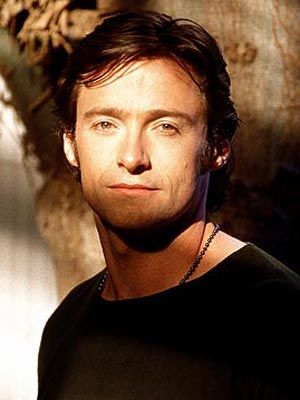
Too, the romance in the first two films comes in the form of a love triangle between Wolverine, Jean Grey, and Jean's husband, Scott aka Cyclops. The set-up is classic Romance Novel 101; Wolverine arrives in a near-death state, awakening to attack the first person he sees - Jean Grey, who has been taking care of him. He's all sorry and so forth for attacking her, she's all forgiving, and the attraction between the two is instantaneous. But Jean is already married and in love with Scott so what she feels for Wolverine and he for her must remain unconsummated. The tension between Wolverine and Scott as they vie for Jean's affections is thick, the two super-studs constantly bickering as they size each other up to see who has the biggest...ahem...superpowers.
Warning - SPOILERS ahead....
In movie two, Jean gives in to her urges and kisses Wolverine. But since she's a superheroine, she begs for mercy from him because she loves her husband and really, really doesn't want to stray, despite the overwhelming desire to do so. Wolverine, being that bad boy with the heart of pure gold that he is, gives poor Jean a break and backs off.
We viewers, however, get to enjoy the brief thrill of a possible Wolverine/Jean pairing when that tricky Mystique (aka, a very blue, very naked Rebecca Romjin) takes on Jean's form and tries to seduce Wolverine. He's a smart one, though, and figures it out before anyone gets naked.

But, since a happily ever after is always impossible for all parties involved in a love triangle and poor Jean will never be truly satisfied with either choice she could make, she decides to make the Big Sacrifice when it's needed for her to save the rest of her X-Men teammates. As you would expect, both Wolverine and Scott are devastated.
I'm a fan of a good love triangle, except for that aforementioned impossible to have a truly happy ending thing because someone is going to end up hurt or dead. I can't say that it worked for me so much in the X-Men movies, but I think this is more a function of lack of character development, thus lack of me really caring or seeing any true sparks and conflict in the situation. When you're making a movie about a bunch of mutant superheroes, including the Big Bad and backstory and action and governmental interference and the like, it's only a given that the romance will get short shrift.
I will say that Hugh and actor James Marsden, who played Scott, did a fine job in acting devastated after losing Jean. I didn't quite feel their pain, but I believed that they felt it.
So, I'm wishing big time that Gambit would show up in X-Men 3 and light up the screen with chemistry with Rogue, worthy of Meljean's shipper-ness. I'm in need of a good 'ship right now since I'm not getting anything anywhere else.
Gads, I'm turning into one of those comic superhero geeks. *G*
Monday, April 17, 2006
You Just Had to Be There
The story idea I'm currently working on and that I've committed to finish by end-of-summer is set on Cape Cod. The town in which it takes place is fictional, but I've set it down in a real place, a place where people who live there or who have visited there will very easily be able to claim foul if I muck it all up.
I've been to Cape Cod. When I was nine. So it's been...oh, a few years ago. I've been doing some major research on the area via books, the internet, and Google Earth (coolest program ever!) to get a general feel for the area, history and the like.
But it's not even close to the same as visiting.
So yesterday I came up with the brilliant idea of taking a trip to Cape Cod. To check it out, take some photos, drive up and down highway 6 and get a sense of the place, the way it smells and sounds, how it looks during different times of the day. I honestly think this is critical if I want my story to ring true.
Problem is, I can't make such a trip until August at the earliest, more likely not even until October. Which leaves me in kind of a pickle. Do I plod onward with the book, ignoring or faking setting until I have a chance to take my trip, after which I can come back and rewrite accordingly? Or do I refocus my energies on a different story, putting my current WIP on the backburner until I have more of this fundamental research completed?
I've been focusing on how important setting authenticity is for me in a story. If I'm not familiar with a location - city, country, environment - I'm really forgiving if the writer gets it all wrong. After all, I certainly don't know any better.
But when a writer places a story in a town I am familiar with, I either smile and nod happily when I recognize things, or I shake my head in disappointment when she (or he) gets it all wrong. Via Sara Donati's Storytelling I found Beth's rant about the pseudo-familiarity of Chicago implied in The Time Traveler's Wife to reflect my own general opinions. The writer seems very familiar with the city, but a consistent mis-use of Chicagoan terms jars those of us in the real know enough to distract from the story. I haven't read TTTW to be able to agree or disagree with Beth on this specific example, but I do agree with her assessment about the way it *should* be for it to ring true to a person actually from Chicago.
It's not just physical descriptions of locations or putting landmarks in their correct geographical place or even getting the local vernacular accurate that poses a challenge for writers. There's something about capturing a place's soul, it's overall feeling that makes such a difference. In a bizarre way, there's almost a responsibility for a writer to "get it right" if only because those not familiar with an area might form expectations based on what they've read. True, those who base their thoughts about a place based on what they've read in fiction rather than checking out non-fiction sources don't deserve much credit on the intelligence scale, yet it happens all the same.
I've said before that although I absolutely loved Lynn Viehl's If Angels Burn and Private Demon books, the one issue I've had with both was her portrayal of Chicago as some kind of menacing place where people live behind closed and locked doors and windows for fear of going out. Certainly there are parts of Chicago where one doesn't wander on purpose, but for the most part, the city is a warm, welcoming place, full of happy, smiling people who are glad to see you. The Chicago Viehl describes is simply not the one I know, and whenever I come across a phrase or descriptive where I feel she's gotten it all wrong, I feel both disappointed and a tad bit angry that others who don't know my city might actually be getting the wrong idea about it based on these books.
Back to my Cape Cod situation. I have in my mind what I imagine Cape Cod - and living there - is like. However, what my imagination invents versus what is real could be completely different. If I were to write an entire story based on my assumptions, I could be looking at a lot of egg on my face. Or, what if I wrote an entire novel only to find out that the setting I've chosen is entirely wrong for the mood I wanted to create? What if I set my couple on a beach that I think is romantic and peaceful - say, Honolulu's Waikiki Beach - only to find out it is actually ridden with crowds of tourists, lined with towering hotels that block out scenic beauty, and has so many strolling vendors hocking cheap souvenirs as to make you want to run screaming? Not that I'm saing Waikiki Beach is like this, but I really have no idea. So setting my couple there might not be so wise.
Anyway, all of this to say I think if a writer wants to write about a place with which she is not familiar, it might behoove her to become familiar. Granted, I don't see it within my power financially or time-wise to take any long trips across the English and Scottish countrysides in order to help me with some historicals I have in the queue. Sometimes research has to be good enough if there is nothing for it.
But for my own situation, I think a trip to New England is doable.
And, dang, what a hardship. Nice, long romantic weekend away with the hubby all in the name of research? Wonder if I can write it off as a work expense, or do I have to sell first?
I've been to Cape Cod. When I was nine. So it's been...oh, a few years ago. I've been doing some major research on the area via books, the internet, and Google Earth (coolest program ever!) to get a general feel for the area, history and the like.
But it's not even close to the same as visiting.
So yesterday I came up with the brilliant idea of taking a trip to Cape Cod. To check it out, take some photos, drive up and down highway 6 and get a sense of the place, the way it smells and sounds, how it looks during different times of the day. I honestly think this is critical if I want my story to ring true.
Problem is, I can't make such a trip until August at the earliest, more likely not even until October. Which leaves me in kind of a pickle. Do I plod onward with the book, ignoring or faking setting until I have a chance to take my trip, after which I can come back and rewrite accordingly? Or do I refocus my energies on a different story, putting my current WIP on the backburner until I have more of this fundamental research completed?
I've been focusing on how important setting authenticity is for me in a story. If I'm not familiar with a location - city, country, environment - I'm really forgiving if the writer gets it all wrong. After all, I certainly don't know any better.
But when a writer places a story in a town I am familiar with, I either smile and nod happily when I recognize things, or I shake my head in disappointment when she (or he) gets it all wrong. Via Sara Donati's Storytelling I found Beth's rant about the pseudo-familiarity of Chicago implied in The Time Traveler's Wife to reflect my own general opinions. The writer seems very familiar with the city, but a consistent mis-use of Chicagoan terms jars those of us in the real know enough to distract from the story. I haven't read TTTW to be able to agree or disagree with Beth on this specific example, but I do agree with her assessment about the way it *should* be for it to ring true to a person actually from Chicago.
It's not just physical descriptions of locations or putting landmarks in their correct geographical place or even getting the local vernacular accurate that poses a challenge for writers. There's something about capturing a place's soul, it's overall feeling that makes such a difference. In a bizarre way, there's almost a responsibility for a writer to "get it right" if only because those not familiar with an area might form expectations based on what they've read. True, those who base their thoughts about a place based on what they've read in fiction rather than checking out non-fiction sources don't deserve much credit on the intelligence scale, yet it happens all the same.
I've said before that although I absolutely loved Lynn Viehl's If Angels Burn and Private Demon books, the one issue I've had with both was her portrayal of Chicago as some kind of menacing place where people live behind closed and locked doors and windows for fear of going out. Certainly there are parts of Chicago where one doesn't wander on purpose, but for the most part, the city is a warm, welcoming place, full of happy, smiling people who are glad to see you. The Chicago Viehl describes is simply not the one I know, and whenever I come across a phrase or descriptive where I feel she's gotten it all wrong, I feel both disappointed and a tad bit angry that others who don't know my city might actually be getting the wrong idea about it based on these books.
Back to my Cape Cod situation. I have in my mind what I imagine Cape Cod - and living there - is like. However, what my imagination invents versus what is real could be completely different. If I were to write an entire story based on my assumptions, I could be looking at a lot of egg on my face. Or, what if I wrote an entire novel only to find out that the setting I've chosen is entirely wrong for the mood I wanted to create? What if I set my couple on a beach that I think is romantic and peaceful - say, Honolulu's Waikiki Beach - only to find out it is actually ridden with crowds of tourists, lined with towering hotels that block out scenic beauty, and has so many strolling vendors hocking cheap souvenirs as to make you want to run screaming? Not that I'm saing Waikiki Beach is like this, but I really have no idea. So setting my couple there might not be so wise.
Anyway, all of this to say I think if a writer wants to write about a place with which she is not familiar, it might behoove her to become familiar. Granted, I don't see it within my power financially or time-wise to take any long trips across the English and Scottish countrysides in order to help me with some historicals I have in the queue. Sometimes research has to be good enough if there is nothing for it.
But for my own situation, I think a trip to New England is doable.
And, dang, what a hardship. Nice, long romantic weekend away with the hubby all in the name of research? Wonder if I can write it off as a work expense, or do I have to sell first?
Subscribe to:
Posts (Atom)